Ch 16: Traveling Waves
Knight Calc - Physics for Scientists and Engineers 5th Edition
Knight Calc5th EditionPhysics for Scientists and EngineersISBN: 9780137344796Not the one you use?Change textbook
Chapter 16, Problem 44

A bat locates insects by emitting ultrasonic 'chirps' and then listening for echoes from the bugs. Suppose a bat chirp has a frequency of 25 kHz. How fast would the bat have to fly, and in what direction, for you to just barely be able to hear the chirp at 20 kHz?

Verified step by step guidance
1
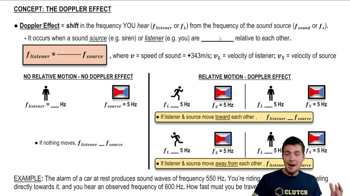
Identify the relevant concept: This problem involves the Doppler Effect, which describes the change in frequency of a wave as observed by an observer moving relative to the source of the wave. The formula for the observed frequency \( f' \) is: \( f' = f \frac{v + v_o}{v - v_s} \), where \( f \) is the source frequency, \( v \) is the speed of sound in air, \( v_o \) is the speed of the observer, and \( v_s \) is the speed of the source. In this case, the bat is the source, and you are stationary (\( v_o = 0 \)).
Rearrange the Doppler Effect formula to solve for the speed of the source \( v_s \): Since the observer is stationary, the formula simplifies to \( f' = f \frac{v}{v - v_s} \). Rearrange this to isolate \( v_s \): \( v_s = v - \frac{v f}{f'} \).
Substitute the known values into the formula: The source frequency \( f \) is 25 kHz, the observed frequency \( f' \) is 20 kHz, and the speed of sound in air \( v \) is approximately 343 m/s (at room temperature). Plug these values into the formula: \( v_s = 343 - \frac{343 \times 25,000}{20,000} \).
Determine the direction of the bat's motion: Since the observed frequency \( f' \) is lower than the source frequency \( f \), the bat must be moving away from you. This is because a lower observed frequency corresponds to a source moving away from the observer in the Doppler Effect.
Interpret the result: After substituting the values and simplifying the expression, you will find the speed \( v_s \) at which the bat must fly away from you for the observed frequency to drop to 20 kHz. Ensure the units are consistent throughout the calculation.

Verified video answer for a similar problem:

This video solution was recommended by our tutors as helpful for the problem above.
Video duration:
2m
Was this helpful?

Key Concepts

Here are the essential concepts you must grasp in order to answer the question correctly.

Doppler Effect

The Doppler Effect is the change in frequency or wavelength of a wave in relation to an observer moving relative to the wave source. In this scenario, as the bat flies towards the observer, the frequency of the chirp increases, while if it moves away, the frequency decreases. This effect is crucial for understanding how the bat's motion alters the frequency of the sound waves it emits.
Recommended video:
Guided course
07:40
The Doppler Effect

Frequency and Pitch

Frequency refers to the number of cycles of a wave that occur in a unit of time, measured in hertz (Hz). In this context, the bat emits sound at 25 kHz, while the observer can only hear it at 20 kHz. The perceived pitch of a sound is directly related to its frequency, making it essential to understand how frequency changes with the bat's movement.
Recommended video:
Guided course
05:08
Circumference, Period, and Frequency in UCM

Speed of Sound

The speed of sound is the distance traveled per unit of time by a sound wave through a medium, typically air. At room temperature, this speed is approximately 343 meters per second. Knowing the speed of sound is vital for calculating how the bat's flight speed affects the frequency of the chirp heard by the observer, as it determines how quickly sound waves propagate.
Recommended video:
Guided course
05:17
Standing Sound Waves