Ch. 15 The Special Senses
Amerman - Human Anatomy & Physiology 2nd Edition
Erin C. Amerman2nd EditionHuman Anatomy & PhysiologyISBN: 9780136873822Not the one you use?Change textbook
Chapter 15, Problem 3

In an olfactory neuron, the binding of a(n) ______ to its membrane receptor triggers a(n) _______ potential in the axons of the ______ nerve.

Verified step by step guidance
1
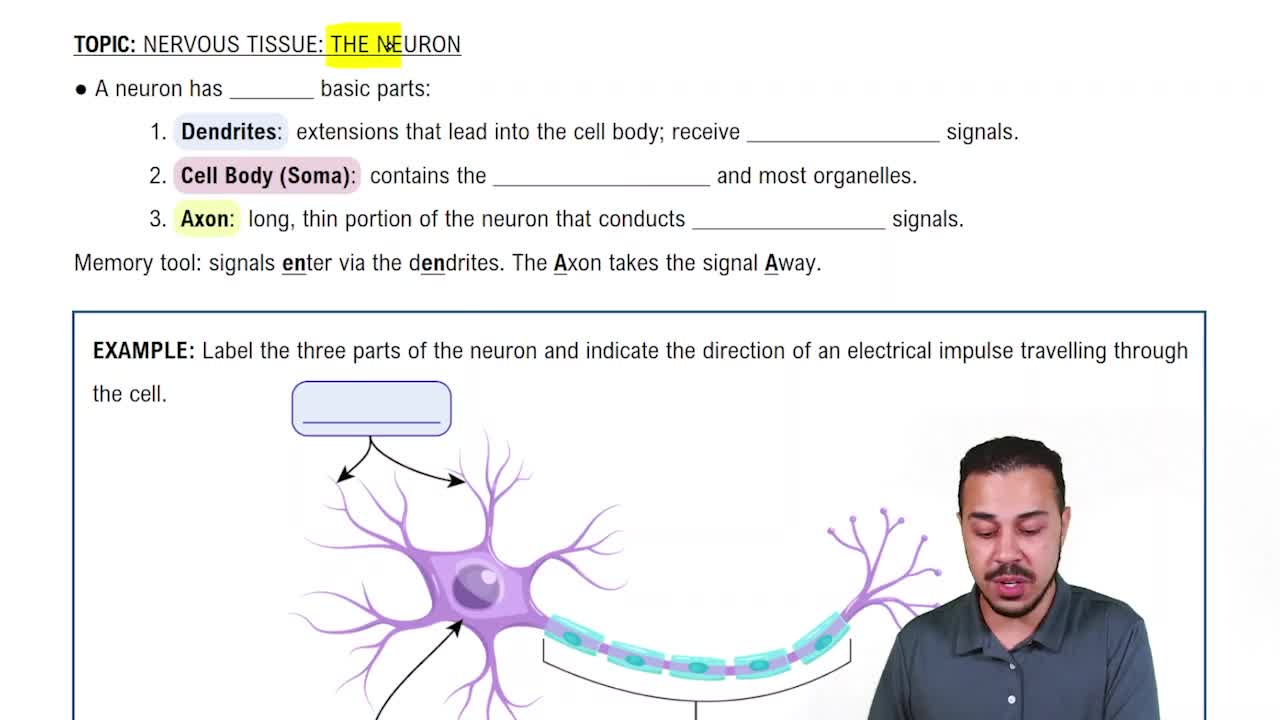
Step 1: Understand the anatomy of the olfactory system. Olfactory neurons are specialized sensory neurons located in the olfactory epithelium of the nasal cavity. These neurons detect odor molecules and transmit signals to the brain via the olfactory nerve.
Step 2: Identify the first blank. The binding of a specific molecule, known as an odorant, to the membrane receptor of the olfactory neuron initiates the process of olfactory signal transduction.
Step 3: Identify the second blank. The binding of the odorant to the receptor triggers a graded electrical response in the neuron, known as a receptor potential. This is a type of local potential that occurs in response to the stimulus.
Step 4: Identify the third blank. The axons of the olfactory neurons bundle together to form the olfactory nerve (cranial nerve I), which transmits the signal to the olfactory bulb in the brain.
Step 5: Summarize the process. The odorant binds to its receptor on the olfactory neuron, triggering a receptor potential, which then propagates along the axons of the olfactory nerve to relay the sensory information to the brain.

Verified video answer for a similar problem:

This video solution was recommended by our tutors as helpful for the problem above.
Was this helpful?

Key Concepts

Here are the essential concepts you must grasp in order to answer the question correctly.

Olfactory Neurons

Olfactory neurons are specialized sensory cells located in the nasal cavity that detect odor molecules. They possess receptors that bind to specific odorants, initiating a signal transduction pathway. This process is crucial for the sense of smell, as it converts chemical signals from the environment into electrical signals that can be interpreted by the brain.
Recommended video:

Receptor Binding

Receptor binding refers to the interaction between a signaling molecule, such as an odorant, and a specific receptor on the surface of a cell. This binding event is essential for activating the receptor, leading to a series of biochemical changes within the neuron. In olfactory neurons, this process ultimately results in the generation of an action potential, which transmits the sensory information.
Recommended video:
3:36
Nucleotide-Binding & Oligomerization Domain (NOD)-Like Receptors

Action Potential

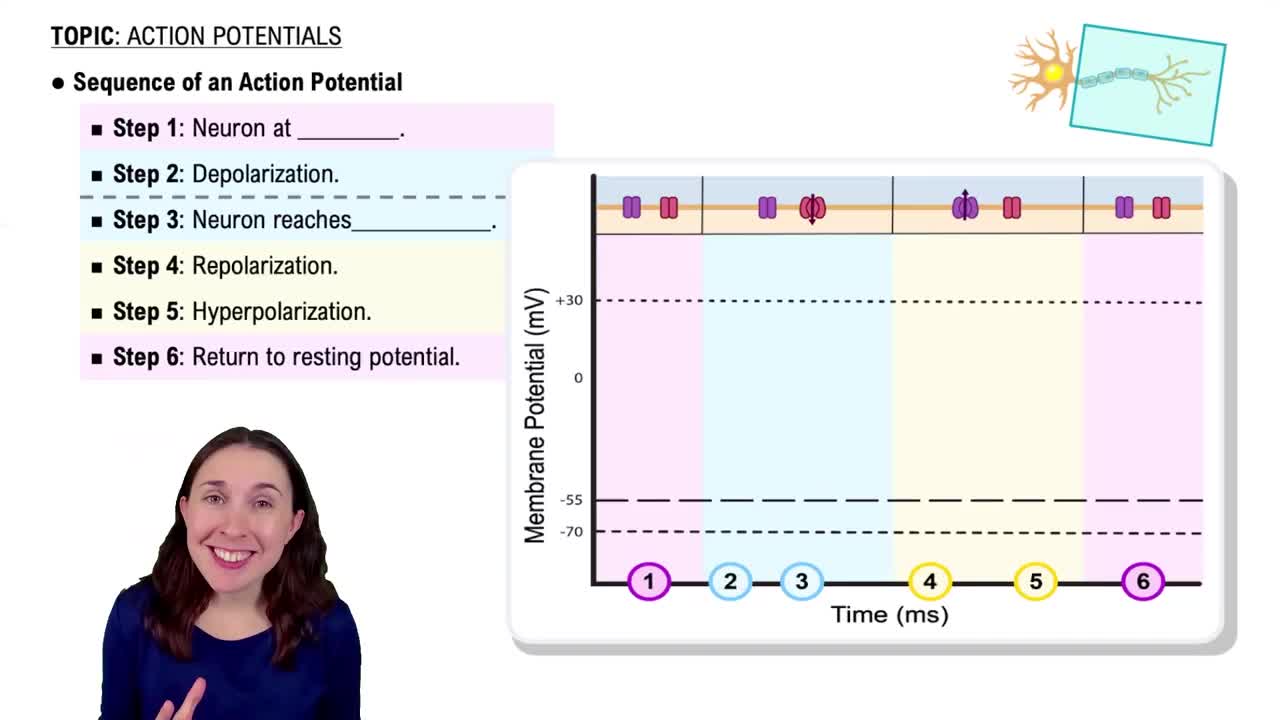
An action potential is a rapid, temporary change in the electrical membrane potential of a neuron, allowing it to transmit signals along its axon. When an olfactory neuron is activated by receptor binding, it depolarizes, leading to the generation of an action potential. This electrical signal travels to the brain, where it is processed and interpreted as a specific smell.
Recommended video:
03:53
Action Potential
Related Practice
Textbook Question

Your 60-year-old patient, Mr. Guster, has Bell's palsy, which causes dysfunction of those portions of the facial nerve that control muscles of facial expression. He is surprised when you tell him to tape the eyelids of his right eye closed at night to prevent dryness. Why might Bell's palsy cause dryness of the eye on the affected side?

455
views
Textbook Question

1. Match the cell type with the correct stimulus. 

_____Rod or cone     

_____Hair cell in cochlea     

_____Gustatory cell     

_____Olfactory neuron     

_____Hair cell in vestibule

a. Head movement

b. Odorant

c. Photon

d. Taste substance

e. Sound wave

563
views
Textbook Question

The axons of the olfactory nerve terminate in the:

a. Olfactory epithelium

b. Olfactory bulb

c. Olfactory tract

d. Primary olfactory cortex

606
views
Textbook Question

The primary olfactory cortex is located in the:

a. Frontal lobe

b. Occipital lobe

c. Parietal lobe

d. Temporal lobe

605
views
Textbook Question

Which of the following statements is true regarding gustatory cells?

a. They have microvilli that project into the taste pore.

b. There are only 10–20 gustatory cells in a typical taste bud.

c. They have a lifespan of approximately 6 months.

d. Some form synapses with neurons that give rise to the trigeminal nerve.

515
views
Textbook Question

Match the taste with the chemical substance that produces it. 

___Sweet      

___Sour     

___Salty      

___Bitter      

___Umami

a. Many alkaloids

b. Sucrose

c. Glutamate

d. Sodium ions

e. Hydrogen ions

502
views