
Ch. 17 The Cardiovascular System I: The Heart
Amerman - Human Anatomy & Physiology 2nd Edition
Erin C. Amerman2nd EditionHuman Anatomy & PhysiologyISBN: 9780136873822Not the one you use?Change textbook
Chapter 17, Problem 2

The pericardial cavity is located between:
a. The parietal pericardium and the fibrous pericardium.
b. The fibrous pericardium and the myocardium.
c. The parietal pericardium and the visceral pericardium.
d. The epicardium and the endocardium.

Verified step by step guidance
1
Understand the anatomy of the pericardium: The pericardium is a double-layered membrane that surrounds the heart. It consists of two main layers: the fibrous pericardium (outermost layer) and the serous pericardium (inner layer). The serous pericardium is further divided into the parietal pericardium (outer layer of the serous pericardium) and the visceral pericardium (inner layer, also known as the epicardium).
Learn about the pericardial cavity: The pericardial cavity is a potential space located between the parietal pericardium and the visceral pericardium. It contains a small amount of lubricating fluid called pericardial fluid, which reduces friction between the heart and surrounding structures during cardiac movements.
Analyze the options provided: Option (a) refers to the parietal pericardium and the fibrous pericardium, which are not separated by the pericardial cavity. Option (b) refers to the fibrous pericardium and the myocardium, which are also not separated by the pericardial cavity. Option (d) refers to the epicardium (another name for the visceral pericardium) and the endocardium, which are layers of the heart itself and not related to the pericardial cavity.
Focus on option (c): The pericardial cavity is specifically located between the parietal pericardium and the visceral pericardium. This matches the anatomical description of the cavity and its location.
Conclude that understanding the layers of the pericardium and their spatial relationships is key to identifying the correct answer. The pericardial cavity is a crucial structure for reducing friction during heart movements.

Verified video answer for a similar problem:

This video solution was recommended by our tutors as helpful for the problem above.
Was this helpful?

Key Concepts

Here are the essential concepts you must grasp in order to answer the question correctly.

Pericardial Cavity

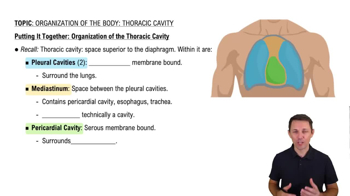
The pericardial cavity is a fluid-filled space that surrounds the heart, providing a protective environment. It is located between the parietal pericardium, which is the outer layer, and the visceral pericardium, which is the inner layer that directly covers the heart. This cavity contains pericardial fluid, which reduces friction during heartbeats.
Recommended video:
Guided course
2:51
Organization of the Thoracic Cavity

Pericardium Layers

The pericardium consists of two main layers: the fibrous pericardium and the serous pericardium. The fibrous pericardium is a tough outer layer that anchors the heart in place, while the serous pericardium is divided into the parietal layer (lining the fibrous pericardium) and the visceral layer (epicardium), which adheres to the heart muscle. Understanding these layers is crucial for identifying the location of the pericardial cavity.
Recommended video:
02:31
Epidermal Layers: Stratum Lucidum (Clear Layer)

Heart Anatomy

A basic understanding of heart anatomy is essential for interpreting the question. The heart is composed of several layers, including the myocardium (the muscular layer), the epicardium (the outer layer), and the endocardium (the inner lining). Recognizing these structures helps clarify the relationships between the pericardial cavity and the surrounding layers, aiding in the correct identification of its location.
Recommended video:
Guided course
6:13
Control of Heart Rate