
Ch. 2 The Chemistry of Life
Amerman - Human Anatomy & Physiology 2nd Edition
Erin C. Amerman2nd EditionHuman Anatomy & PhysiologyISBN: 9780136873822Not the one you use?Change textbook
Chapter 2, Problem 8

Match the following terms with the correct definition:
      Endergonic reaction
      Potential energy
      Electrical energy
      Anabolic reaction
      Oxidation-reduction reaction
      Chemical energy
      Catabolic reaction
      Kinetic energy
a. Energy in motion
b. Energy stored in chemical bonds
c. Reaction that consumes energy
d. A decomposition reaction
e. The energy of moving charged particles
f. Stored energy
g. Synthesis reaction
h. Reaction where electrons are transferred between reactants  

Verified step by step guidance
1
Step 1: Understand the definitions of the terms provided in the problem. For example: Endergonic reaction involves energy consumption, Potential energy refers to stored energy, Electrical energy involves moving charged particles, etc.
Step 2: Match each term with its corresponding definition based on its characteristics. For example, 'Endergonic reaction' matches with 'Reaction that consumes energy' because it requires energy input.
Step 3: Continue matching terms systematically. For instance, 'Potential energy' matches with 'Stored energy' because it refers to energy that is not currently in motion but has the potential to do work.
Step 4: Use the process of elimination to ensure that each term is matched with the most appropriate definition. For example, if 'Kinetic energy' matches with 'Energy in motion,' then it cannot match with any other definition.
Step 5: Double-check all matches to ensure accuracy and consistency. Verify that each term aligns with its definition based on your understanding of Anatomy & Physiology concepts.

Verified video answer for a similar problem:

This video solution was recommended by our tutors as helpful for the problem above.
Was this helpful?

Key Concepts

Here are the essential concepts you must grasp in order to answer the question correctly.

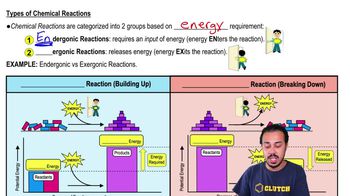
Endergonic Reaction

An endergonic reaction is a type of chemical reaction that requires an input of energy to proceed. This energy is often derived from the surroundings, making the reaction non-spontaneous. In biological systems, endergonic reactions are crucial for processes such as photosynthesis, where energy from sunlight is absorbed to convert carbon dioxide and water into glucose.
Recommended video:
05:48
Types of Chemical Reactions

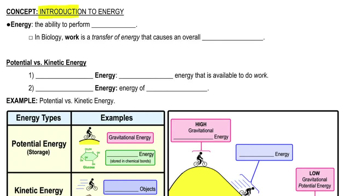
Potential Energy

Potential energy is the stored energy in an object due to its position or arrangement. In the context of chemistry, it often refers to the energy stored in chemical bonds, which can be released during chemical reactions. Understanding potential energy is essential for grasping how energy transformations occur in both physical and biological systems.
Recommended video:
4:58
Introduction to Energy

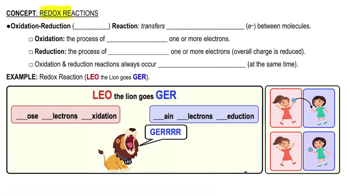
Oxidation-Reduction Reaction

An oxidation-reduction (redox) reaction involves the transfer of electrons between two substances. In this process, one substance is oxidized (loses electrons) while the other is reduced (gains electrons). Redox reactions are fundamental in various biological processes, including cellular respiration and photosynthesis, as they facilitate energy transfer and storage.
Recommended video:
04:46
Redox Reactions