A relation is a connection between inputs (x-values) and outputs (y-values), often represented as a set of ordered pairs in the form \((x, y)\). To understand relations, you can list all the input values and output values separately and then show how each input corresponds to an output. For example, given ordered pairs like \((-2, 2)\), \((1, 1)\), \((3, -2)\), and \((1, 4)\), the inputs are \(-2\), \(1\), and \(3\), while the outputs are \(2\), \(1\), \(-2\), and \(4\). Notice that the input \(1\) corresponds to two different outputs, \(1\) and \(4\).
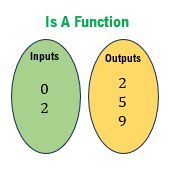
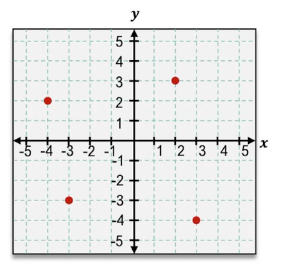
A function is a special type of relation where each input is paired with at most one output. This means no input value maps to more than one output value. For instance, if you have ordered pairs like \((-4, 2)\), \((-2, -1)\), \((1, 2)\), and \((3, 4)\), each input corresponds to exactly one output. Here, \(-4\) maps to \(2\), \(-2\) maps to \(-1\), \(1\) maps to \(2\), and \(3\) maps to \(4\). Since no input repeats with different outputs, this relation qualifies as a function.
It is important to recognize that all functions are relations, but not all relations are functions. This distinction hinges on whether each input has a unique output.
Relations and functions can be represented in various ways beyond ordered pairs. They can be shown as correspondences, tables, graphs, or equations. For example, a function can be expressed as an equation like \(y = 2x + 3\), which defines a unique output \(y\) for each input \(x\).
Understanding the difference between relations and functions is fundamental in mathematics, as it helps in analyzing how variables depend on each other and in identifying valid functions for modeling real-world scenarios.