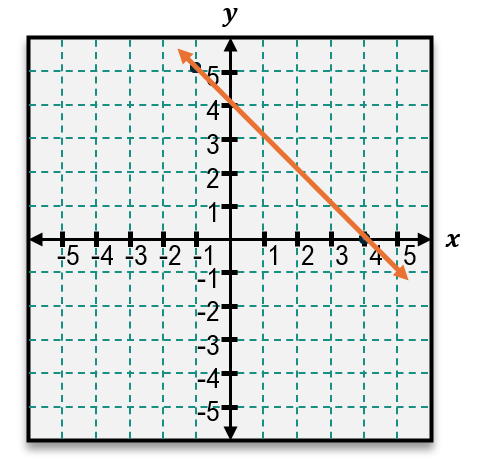
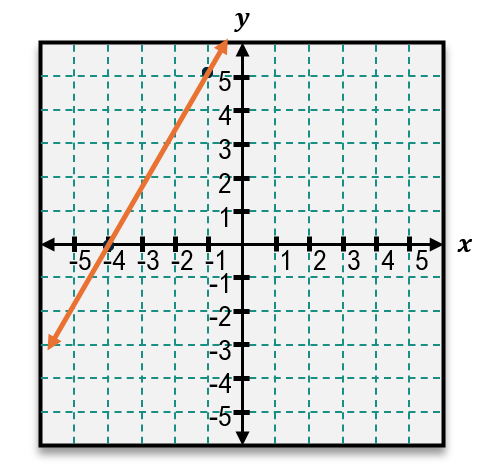
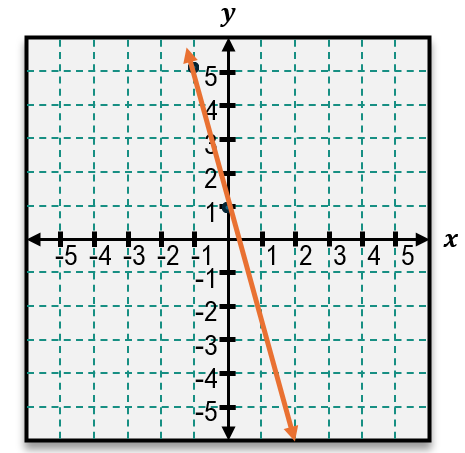
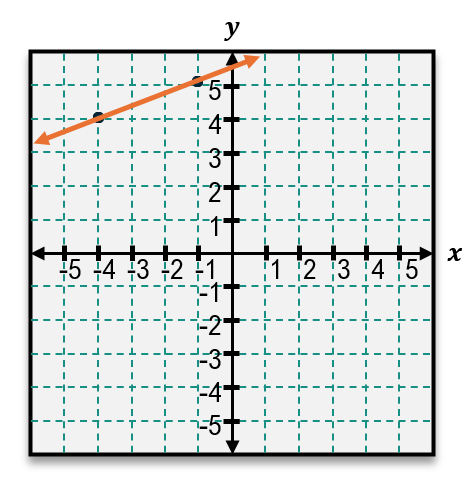
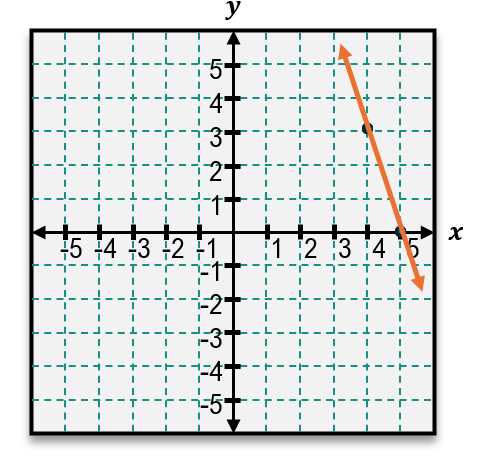
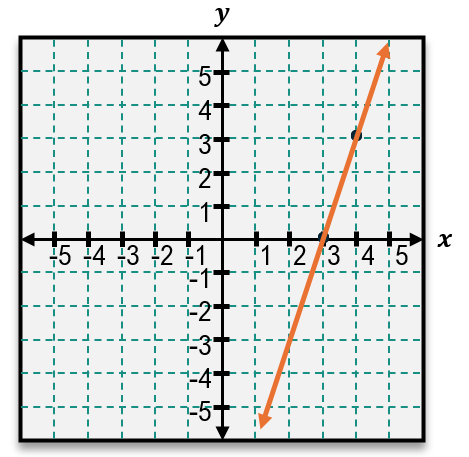
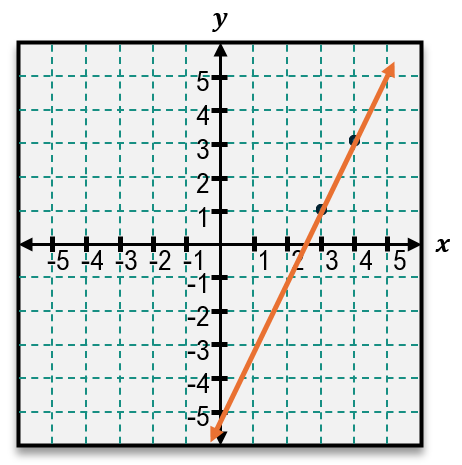
The slope of a line is a fundamental concept in understanding the characteristics of linear equations. Represented by the letter m, the slope measures the steepness or incline of a line. It is calculated by dividing the vertical change, known as the rise, by the horizontal change, called the run. This relationship is often expressed as rise over run, which quantifies how much the line goes up or down for each unit it moves horizontally.
To find the slope from a graph, identify two points on the line and determine the difference in their y-coordinates (rise) and x-coordinates (run). For example, if the rise is 3 units and the run is 1 unit, the slope is calculated as:
\[m = \frac{\text{rise}}{\text{run}} = \frac{3}{1} = 3\]This means the line rises 3 units vertically for every 1 unit it moves horizontally, indicating a relatively steep incline.
A more formal and widely used method to calculate slope involves using the coordinates of two points, labeled as \((x_1, y_1)\) and \((x_2, y_2)\). The slope formula is:
\[m = \frac{y_2 - y_1}{x_2 - x_1}\]Here, the numerator represents the change in y-values (vertical change), and the denominator represents the change in x-values (horizontal change). This formula can also be expressed using the Greek letter delta (Δ), which signifies change:
\[m = \frac{\Delta y}{\Delta x}\]For instance, if the two points are \((-1, 0)\) and \((0, 3)\), the slope calculation would be:
\[m = \frac{3 - 0}{0 - (-1)} = \frac{3}{1} = 3\]This confirms the slope found by observing the graph directly.
It is important to note that when using the slope formula, the order of subtraction must be consistent. However, it does not matter which point is chosen as \((x_1, y_1)\) or \((x_2, y_2)\), as long as the same order is used for both the numerator and denominator.
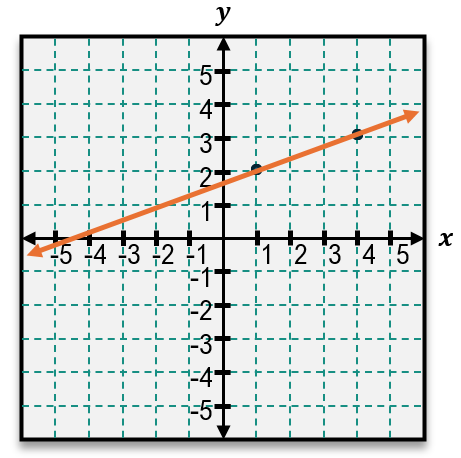
When given only two points without a graph, the slope can still be found using the same formula. For example, with points \((1, 2)\) and \((4, 5)\), the slope is:
\[m = \frac{5 - 2}{4 - 1} = \frac{3}{3} = 1\]This slope of 1 indicates a less steep line compared to a slope of 3, reflecting the different inclines of the two lines.
Understanding how to calculate slope is essential for analyzing linear relationships, graphing lines, and solving problems involving rates of change. Mastery of this concept enables deeper comprehension of algebraic functions and their graphical representations.