


Ch. 22 - Descent with Modification: A Darwininan View of Life
Chapter 22, Problem 7

A swim bladder is a gas-filled sac that helps fish maintain buoyancy. The evolution of the swim bladder from the air-breathing organ (a simple lung) of an ancestral fish is an example of
a. Exaptation.
b. Changes in Hox gene expression.
c. Paedomorphosis.
d. Adaptive radiation.

Verified step by step guidance
1
Understand the concept of exaptation: Exaptation refers to a trait that has been co-opted for a use other than the one for which natural selection has built it. In this context, the swim bladder evolved from an air-breathing organ, which is an example of exaptation.
Consider the role of Hox genes: Hox genes are involved in the regulation of patterns of anatomical development (morphogenesis) in animals. Changes in Hox gene expression can lead to significant evolutionary changes, but this is not directly related to the evolution of the swim bladder.
Define paedomorphosis: Paedomorphosis is the retention of juvenile features in the adult organism. This concept does not apply to the evolution of the swim bladder from an air-breathing organ.
Understand adaptive radiation: Adaptive radiation is the process by which organisms diversify rapidly into a multitude of new forms, particularly when a change in the environment makes new resources available. This is not directly related to the evolution of the swim bladder.
Identify the correct answer: Based on the definitions and explanations, the evolution of the swim bladder from an air-breathing organ is best described as an example of exaptation.

Verified video answer for a similar problem:

This video solution was recommended by our tutors as helpful for the problem above.
Video duration:
1m
Was this helpful?

Key Concepts

Here are the essential concepts you must grasp in order to answer the question correctly.

Exaptation

Exaptation refers to a trait that has been co-opted for a use other than the one for which natural selection has built it. In the context of the swim bladder, it originally evolved as an air-breathing organ (a simple lung) in ancestral fish and later adapted to help with buoyancy. This illustrates how structures can evolve new functions over time.
Recommended video:
06:15
Origin of Complex Traits

Hox Gene Expression

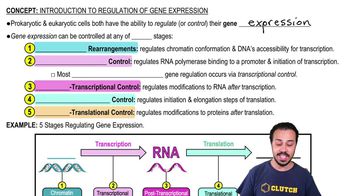
Hox genes are a group of related genes that control the body plan of an embryo along the head-tail axis. Changes in Hox gene expression can lead to significant evolutionary transformations by altering the development of structures. However, in the case of the swim bladder, the focus is on functional adaptation rather than developmental changes driven by Hox genes.
Recommended video:
Guided course
06:40
Introduction to Regulation of Gene Expression

Adaptive Radiation

Adaptive radiation is the process by which organisms diversify rapidly into a multitude of new forms, particularly when a change in the environment makes new resources available. While adaptive radiation explains the diversification of species, the evolution of the swim bladder is more about the modification of an existing structure for a new function, rather than the rapid emergence of new species.
Recommended video:
05:24
Adaptive Radiation
Related Practice
Textbook Question

Within six months of effectively using methicillin to treat S. aureus infections in a community, all new S. aureus infections were caused by MRSA. How can this best be explained?

a. A patient must have become infected with MRSA from another community.

b. In response to the drug, S. aureus began making drug- resistant versions of the protein targeted by the drug.

c. Some drug-resistant bacteria were present at the start of treatment, and natural selection increased their frequency.

d. S. aureus evolved to resist vaccines.

1946
views
Textbook Question

DNA sequences in many human genes are very similar to the sequences of corresponding genes in chimpanzees. The most likely explanation for this result is that

a. Humans and chimpanzees share a relatively recent common ancestor.

b. Humans evolved from chimpanzees.

c. Chimpanzees evolved from humans.

d. Convergent evolution led to the DNA similarities.

1906
views
Textbook Question

The upper forelimbs of humans and bats have fairly similar skeletal structures, whereas the corresponding bones in whales have very different shapes and proportions. However, genetic data suggest that all three kinds of organisms diverged from a common ancestor at about the same time. Which of the following is the most likely explanation for these data?

a. Forelimb evolution was adaptive in people and bats, but not in whales.

b. Natural selection in an aquatic environment resulted in significant changes to whale forelimb anatomy.

c. Genes mutate faster in whales than in humans or bats.

d. Whales are not properly classified as mammals.

3054
views