
Pearson+ LogoPearson+ Logo
Ch. 23 - The Evolution of Populations
Campbell - Campbell Biology 12th Edition
Urry12th EditionCampbell BiologyISBN: 9785794169850Not the one you use?Change textbook
Chapter 23, Problem 5

A fruit fly population has a gene with two alleles, A1 and A2. Tests show that 70% of the gametes produced in the population contain the A1 allele. If the population is in Hardy-Weinberg equilibrium, what proportion of the flies carry both A1 and A2?
a. 0.7
b. 0.49
c. 0.42
d. 0.21

Verified step by step guidance
1
First, understand that the Hardy-Weinberg equilibrium principle states that allele and genotype frequencies in a population will remain constant from generation to generation in the absence of other evolutionary influences.
Given that 70% of the gametes contain the A1 allele, the frequency of A1 (p) is 0.7. Consequently, the frequency of the A2 allele (q) can be calculated as 1 - p, which is 1 - 0.7.
Calculate the frequency of the A2 allele: q = 1 - 0.7 = 0.3.
In Hardy-Weinberg equilibrium, the proportion of heterozygous individuals (carrying both A1 and A2 alleles) is given by the formula 2pq, where p is the frequency of A1 and q is the frequency of A2.
Substitute the values of p and q into the formula: 2pq = 2 * 0.7 * 0.3. This will give you the proportion of flies that are heterozygous (A1A2).

Verified video answer for a similar problem:

This video solution was recommended by our tutors as helpful for the problem above.
Video duration:
3m
Was this helpful?

Key Concepts

Here are the essential concepts you must grasp in order to answer the question correctly.

Hardy-Weinberg Equilibrium

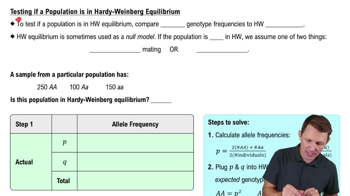
The Hardy-Weinberg equilibrium is a principle that states that allele and genotype frequencies in a population will remain constant from generation to generation in the absence of evolutionary influences. These influences include mutation, selection, gene flow, genetic drift, and non-random mating. It provides a mathematical model to study genetic variation in populations.
Recommended video:
08:26
Testing if a Population is in Hardy-Weinberg Equilibrium

Allele Frequency

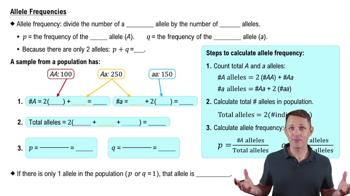
Allele frequency refers to how common an allele is in a population. It is calculated as the number of copies of a specific allele divided by the total number of all alleles for that gene in the population. In this question, the allele frequency of A1 is given as 0.7, meaning 70% of the gametes carry the A1 allele.
Recommended video:
06:36
Allele Frequencies

Genotype Frequency Calculation

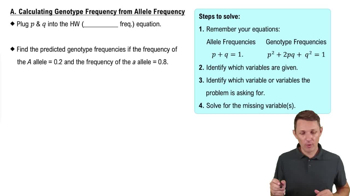
In a population in Hardy-Weinberg equilibrium, the genotype frequencies can be calculated using the allele frequencies. For two alleles, A1 and A2, the frequency of the heterozygous genotype (A1A2) is given by 2pq, where p is the frequency of A1 and q is the frequency of A2. Given p = 0.7, q can be calculated as 1 - p = 0.3, leading to a heterozygous frequency of 2(0.7)(0.3) = 0.42.
Recommended video:
03:30
A. Calculating Genotype Frequency from Allele Frequency