
Ch. 24 - The Origin of Species
Campbell - Campbell Biology 12th Edition
Urry12th EditionCampbell BiologyISBN: 9785794169850Not the one you use?Change textbook
Chapter 24, Problem 2

Males of different species of the fruit fly Drosophila that live in the same parts of the Hawaiian Islands have different elaborate courtship rituals. These rituals involve fighting other males and making stylized movements that attract females. What type of reproductive isolation does this represent?
a. Habitat isolation
b. Temporal isolation
c. Behavioral isolation
d. Gametic isolation

Verified step by step guidance
1
Begin by understanding the concept of reproductive isolation, which prevents different species from interbreeding and producing fertile offspring.
Identify the types of reproductive isolation: habitat isolation, temporal isolation, behavioral isolation, and gametic isolation.
Consider the details provided in the problem: males of different species have elaborate courtship rituals involving fighting and stylized movements.
Recognize that these courtship rituals are specific behaviors that attract females of the same species, indicating a form of isolation based on behavior.
Conclude that the type of reproductive isolation described in the problem is behavioral isolation, as it involves specific actions and signals that prevent interbreeding between species.

Verified video answer for a similar problem:

This video solution was recommended by our tutors as helpful for the problem above.
Video duration:
2m
Was this helpful?

Key Concepts

Here are the essential concepts you must grasp in order to answer the question correctly.

Reproductive Isolation

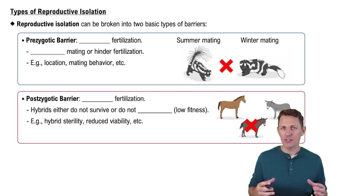
Reproductive isolation refers to mechanisms that prevent species from mating with each other, thus maintaining species boundaries. It can be prezygotic, preventing fertilization, or postzygotic, affecting the viability of offspring. Understanding these mechanisms is crucial for studying speciation and evolutionary biology.
Recommended video:
02:47
Types of Reproductive Isolation

Behavioral Isolation

Behavioral isolation is a form of prezygotic reproductive isolation where differences in mating rituals or behaviors prevent interbreeding between species. In the case of Drosophila, distinct courtship rituals act as barriers, ensuring that mating occurs only within the same species, thus maintaining species integrity.
Recommended video:

Courtship Rituals

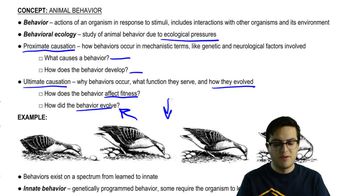
Courtship rituals are specific behaviors exhibited by animals to attract mates, often involving complex displays or actions. These rituals are crucial for sexual selection and can lead to behavioral isolation when they differ significantly between species, as seen in the Drosophila species in Hawaii.
Recommended video:
Guided course
05:37
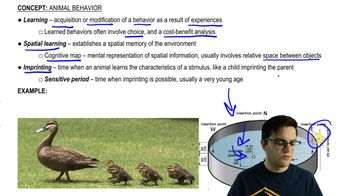
Learning and Communication
Related Practice
Textbook Question

The largest unit within which gene flow can readily occur is a

a. Population.

b. Species.

c. Genus.

d. Hybrid.

1207
views
Textbook Question

According to the punctuated equilibria model:

a. Given enough time, most existing species will branch gradually into new species.

b. Most new species accumulate their unique features relatively rapidly as they come into existence, then change little for the rest of their duration as a species.

c. Most evolution occurs in sympatric populations.

d. Speciation is usually due to a single mutation.

1598
views
Textbook Question

Bird guides once listed the myrtle warbler and Audubon's warbler as distinct species. Recently, these birds have been classified as eastern and western forms of a single species, the yellow-rumped warbler. Which of the following pieces of evidence, if true, would be cause for this reclassification?

a. The two forms interbreed often in nature, and their offspring survive and reproduce well.

b. The two forms live in similar habitats and have similar food requirements.

c. The two forms have many genes in common.

d. The two forms are very similar in appearance.

1399
views
Textbook Question

Which of the following factors would be the most likely to contribute to allopatric speciation?

a. The separated population is large, and genetic drift occurs.

b. Selection pressures in the isolated population are similar to those in the ancestral population.

c. Gene flow between the two populations is extensive.

d. Different mutations begin to distinguish the gene pools of the separated populations.

287
views