Pearson+ LogoPearson+ Logo
Ch. 25 - The History of Life on Earth
Campbell - Campbell Biology 12th Edition
Urry12th EditionCampbell BiologyISBN: 9785794169850Not the one you use?Change textbook
Chapter 25, Problem 4a

Large-scale, worldwide adaptive radiations have occurred in which of the following situations?
a. When there are no available ecological niches
b. After each of the big five mass extinctions
c. Aafter colonization of an isolated island that contains suitable habitat and few competitor species
d. Whenever an evolutionary innovation was needed for organisms to thrive

Verified step by step guidance
1
Understand the concept of adaptive radiation: Adaptive radiation refers to the rapid evolution of diverse species from a common ancestor when new ecological opportunities arise. This often happens when organisms encounter environments with unoccupied niches or reduced competition.
Analyze the role of ecological niches: Adaptive radiation typically occurs when ecological niches are available, allowing species to diversify and adapt to different roles in the ecosystem. This eliminates option 'a' since adaptive radiation does not occur when there are no available niches.
Examine the impact of mass extinctions: Mass extinctions create opportunities for adaptive radiation by eliminating dominant species, freeing up ecological niches for surviving organisms to diversify. This supports option 'b' as a correct scenario.
Consider colonization of isolated islands: When species colonize isolated islands with suitable habitats and few competitors, they often undergo adaptive radiation to exploit the available niches. This supports option 'c' as another correct scenario.
Evaluate evolutionary innovations: While evolutionary innovations can help organisms thrive, they are not a direct cause of adaptive radiation. Adaptive radiation is more closely tied to ecological opportunities rather than the need for innovation, making option 'd' less relevant.

Verified video answer for a similar problem:

This video solution was recommended by our tutors as helpful for the problem above.
Video duration:
2m
Was this helpful?

Key Concepts

Here are the essential concepts you must grasp in order to answer the question correctly.

Adaptive Radiation

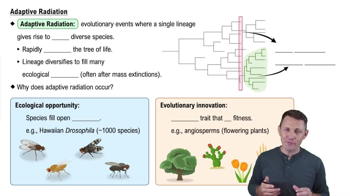
Adaptive radiation is an evolutionary process where organisms diversify rapidly into a wide variety of forms to adapt to different environments. This often occurs when a species colonizes a new habitat with available ecological niches, leading to the emergence of new species that exploit these niches. Understanding this concept is crucial for analyzing how and why large-scale radiations happen in response to environmental changes.
Recommended video:
05:24
Adaptive Radiation

Mass Extinctions

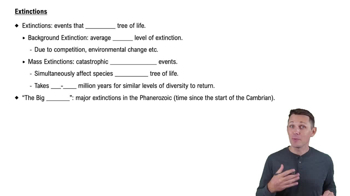
Mass extinctions are significant and rapid decreases in biodiversity on Earth, often resulting from catastrophic events such as asteroid impacts or volcanic eruptions. The five major mass extinctions in Earth's history have led to the loss of a large number of species, but they also create opportunities for surviving species to diversify and fill the vacated ecological niches, often resulting in adaptive radiations.
Recommended video:
04:48
Extinctions

Ecological Niches

An ecological niche refers to the role and position a species has in its environment, including its habitat, resource use, and interactions with other organisms. The availability of ecological niches is a key factor in adaptive radiation, as it allows new species to evolve and thrive in different environments. Understanding niches helps explain why certain events, like mass extinctions or colonization of isolated areas, can trigger rapid diversification.
Related Practice
Textbook Question

The oxygen revolution changed Earth's environment dramatically. Which of the following took advantage of the presence of free oxygen in the oceans and atmosphere?

a. The evolution of cellular respiration, which used oxygen to help harvest energy from organic molecules

b. The persistence of some animal groups in anaerobic habitats

c. The evolution of photosynthetic pigments that protected early algae from the corrosive effects of oxygen

d. The evolution of chloroplasts after early protists incorporated photosynthetic cyanobacteria

2004
views
Textbook Question

Which factor most likely caused animals and plants in India to differ greatly from species in nearby Southeast Asia?

a. The species became separated by convergent evolution.

b. The climates of the two regions are similar.

c. India is in the process of separating from the rest of Asia.

d. India was a separate continent until 45 million years ago.

1294
views
Textbook Question
Large-scale, worldwide adaptive radiations have occurred in which of the following situations?(A)when there are no available ecological niches(B)after each of the big five mass extinctions(C)after colonization of an isolated island that contains suit-able habitat and few competitor species(D)whenever an evolutionary innovation was needed for or-ganisms to thrive
1430
views
Textbook Question
Scientists studying the origin of life have accomplished which of the following steps?(A)abiotic synthesis of protocells with self-replicating, catalytic RNA(B)formation of vesicles that use RNA as a template for DNA synthesis(C)formation of protocells that use DNA to direct the polymer-ization of amino acids(D)abiotic synthesis of RNA's bases (A, C, G, U)
2553
views
Textbook Question

Scientists studying the origin of life have accomplished which of the following steps?

a. Abiotic synthesis of protocells with self-replicating, catalytic RNA

b. Formation of vesicles that use RNA as a template for DNA synthesis

c. Formation of protocells that use DNA to direct the polymerization of amino acids

d. Abiotic synthesis of RNA’s bases (A, C, G, U)

351
views
Textbook Question

A genetic change that caused a certain Hox gene to be expressed along the tip of a vertebrate limb bud instead of farther back helped make possible the evolution of the tetrapod limb. This type of change is illustrative of

a. The influence of environment on development.

b. Paedomorphosis.

c. A change in a developmental gene or in its regulation that altered the spatial organization of body parts.

d. Heterochrony.

1728
views