Pearson+ LogoPearson+ Logo
Ch. 3 - Water and Life
Campbell - Campbell Biology 12th Edition
Urry12th EditionCampbell BiologyISBN: 9785794169850Not the one you use?Change textbook
Chapter 3, Problem 6

Draw the hydration shells that form around a potassium ion and a chloride ion when potassium chloride (KCl) dissolves in water. Label the positive, negative, and partial charges on the atoms.

Verified step by step guidance
1
Begin by understanding that when potassium chloride (KCl) dissolves in water, it dissociates into potassium ions (K⁺) and chloride ions (Cl⁻). These ions interact with water molecules, forming hydration shells.
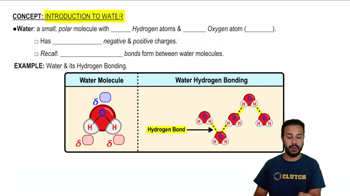
Identify the structure of a water molecule, which consists of two hydrogen atoms and one oxygen atom. The oxygen atom has a partial negative charge (δ⁻), while the hydrogen atoms have partial positive charges (δ⁺).
For the potassium ion (K⁺), draw several water molecules around it. The oxygen atoms of the water molecules, which have partial negative charges, will orient themselves towards the positively charged potassium ion.
For the chloride ion (Cl⁻), draw several water molecules around it. The hydrogen atoms of the water molecules, which have partial positive charges, will orient themselves towards the negatively charged chloride ion.
Label the charges: Indicate the positive charge on the potassium ion (K⁺), the negative charge on the chloride ion (Cl⁻), and the partial charges on the water molecules (δ⁺ on hydrogen and δ⁻ on oxygen). This labeling helps visualize the electrostatic interactions forming the hydration shells.

Verified video answer for a similar problem:

This video solution was recommended by our tutors as helpful for the problem above.
Video duration:
1m
Was this helpful?

Key Concepts

Here are the essential concepts you must grasp in order to answer the question correctly.

Hydration Shells

Hydration shells are layers of water molecules that surround ions when they dissolve in water. The polar nature of water allows it to interact with charged particles, forming a shell where the water's partial charges align with the ion's charge, stabilizing the ion in solution.
Recommended video:
Guided course
09:44
Electron Orbitals & Energy Shells

Polarity of Water

Water is a polar molecule, meaning it has a partial positive charge on the hydrogen atoms and a partial negative charge on the oxygen atom. This polarity enables water to interact with and stabilize ions in solution, as the opposite charges attract, forming hydration shells around dissolved ions.
Recommended video:
Guided course
01:54
Introduction to Water

Ion Dissolution

When ionic compounds like potassium chloride dissolve in water, the ions separate and become surrounded by water molecules. This process involves the breaking of ionic bonds and the formation of new interactions between the ions and water, facilitated by the polar nature of water molecules.
Recommended video:
Guided course
04:51
Ion Exclusion