Pearson+ LogoPearson+ Logo
Ch. 3 - Water and Life
Campbell - Campbell Biology 12th Edition
Urry12th EditionCampbell BiologyISBN: 9785794169850Not the one you use?Change textbook
Chapter 3, Problem 3

Measurements show that the pH of a particular lake is 4.0. What is the hydrogen ion concentration of the lake?
a. 4.0 M
b. 10¹⁰M
c. 10⁴M
d. 104M

Verified step by step guidance
1
Understand that pH is a measure of the hydrogen ion concentration in a solution. The pH scale ranges from 0 to 14, where lower values indicate higher acidity and higher hydrogen ion concentration.
Recall the formula for calculating pH: \( \text{pH} = -\log_{10}[H^+] \), where \([H^+]\) is the hydrogen ion concentration in moles per liter (M).
Given that the pH of the lake is 4.0, use the formula to find the hydrogen ion concentration: \( 4.0 = -\log_{10}[H^+] \).
To solve for \([H^+]\), rearrange the equation: \([H^+] = 10^{-4} \text{ M}\). This is because taking the antilogarithm (inverse of log) of -4 gives \(10^{-4}\).
Compare the calculated hydrogen ion concentration \(10^{-4} \text{ M}\) with the given options to identify the correct answer.

Verified video answer for a similar problem:

This video solution was recommended by our tutors as helpful for the problem above.
Video duration:
1m
Was this helpful?

Key Concepts

Here are the essential concepts you must grasp in order to answer the question correctly.

pH Scale

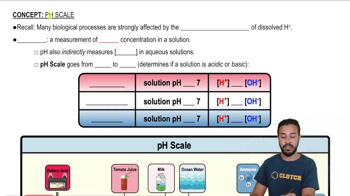
The pH scale is a measure of the acidity or alkalinity of a solution, ranging from 0 to 14. A pH of 7 is neutral, below 7 is acidic, and above 7 is basic. The pH value is the negative logarithm (base 10) of the hydrogen ion concentration, which means a lower pH indicates a higher concentration of hydrogen ions.
Recommended video:

Hydrogen Ion Concentration

Hydrogen ion concentration refers to the amount of hydrogen ions present in a solution, which determines its acidity. It is expressed in moles per liter (M). The relationship between pH and hydrogen ion concentration is given by the formula: [H+] = 10^(-pH), where [H+] is the concentration of hydrogen ions.
Recommended video:
Guided course
05:03
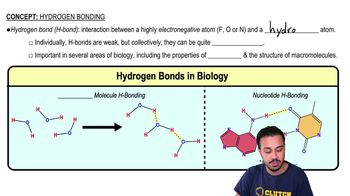
Hydrogen Bonding

Logarithmic Calculations

Logarithmic calculations are used to convert between pH and hydrogen ion concentration. Since pH is the negative logarithm of the hydrogen ion concentration, calculating the concentration involves using the inverse operation: [H+] = 10^(-pH). For a pH of 4.0, the hydrogen ion concentration is 10^(-4) M, which is 0.0001 M.
Recommended video:
Guided course
02:10
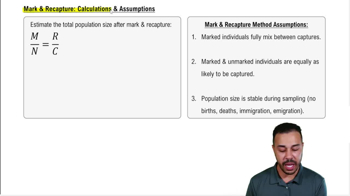
Mark & Recapture: Calculations & Assumptions