
Pearson+ LogoPearson+ Logo
Ch. 36 - Resource Acquisition and Transport in Vascular Plants
Campbell - Campbell Biology 12th Edition
Urry12th EditionCampbell BiologyISBN: 9785794169850Not the one you use?Change textbook
Chapter 36, Problem 6

A plant cell with a ΨS of −0.65MPa maintains a constant volume when bathed in a solution that has a ΨS of −0.30MPa and is in an open container. The cell has a
a. ΨP of +0.65MPa
b. Ψ of −0.65MPa
c. ΨP of +0.35MPa
d. ΨP of 0 MPa

Verified step by step guidance
1
Understand the concept of water potential (Ψ), which is the sum of solute potential (ΨS) and pressure potential (ΨP). The formula is Ψ = ΨS + ΨP.
Recognize that the plant cell maintains a constant volume, indicating that the water potential inside the cell is equal to the water potential of the surrounding solution.
Given that the solute potential (ΨS) of the cell is −0.65 MPa, and the solute potential of the surrounding solution is −0.30 MPa, calculate the pressure potential (ΨP) of the cell using the formula Ψ = ΨS + ΨP.
Since the cell is in an open container, the pressure potential of the surrounding solution is 0 MPa. Therefore, the water potential of the solution is Ψ = ΨS + ΨP = −0.30 MPa + 0 MPa = −0.30 MPa.
Set the water potential of the cell equal to the water potential of the solution to find the pressure potential of the cell: Ψ(cell) = Ψ(solution). Substitute the known values into the equation: ΨS(cell) + ΨP(cell) = ΨS(solution) + ΨP(solution).

Verified video answer for a similar problem:

This video solution was recommended by our tutors as helpful for the problem above.
Video duration:
1m
Was this helpful?

Key Concepts

Here are the essential concepts you must grasp in order to answer the question correctly.

Water Potential (Ψ)

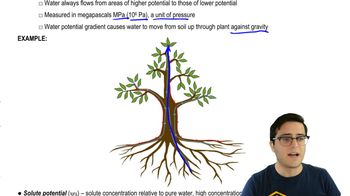
Water potential (Ψ) is a measure of the potential energy in water, influencing the movement of water in plant cells. It is determined by solute potential (ΨS) and pressure potential (ΨP). Water moves from areas of higher water potential to lower water potential, and understanding this concept is crucial for analyzing water movement in plant cells.
Recommended video:
Guided course
11:32
Water Potential

Solute Potential (ΨS)

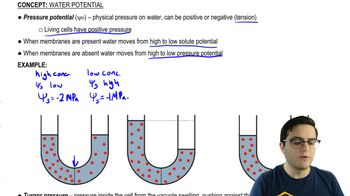
Solute potential (ΨS), also known as osmotic potential, is the component of water potential that accounts for the effect of solute concentration. It is always negative or zero, as solutes lower the water potential. In the given question, the solute potential of the plant cell and the bathing solution are key to determining the pressure potential needed to maintain constant cell volume.
Recommended video:
Guided course
11:32
Water Potential

Pressure Potential (ΨP)

Pressure potential (ΨP) is the component of water potential that results from the physical pressure exerted on water in a cell. It can be positive, negative, or zero, and is crucial for maintaining cell turgor and volume. In the question, calculating ΨP helps determine the balance between solute potential and the external solution to keep the cell's volume constant.
Recommended video:
Guided course
11:58
Pressure Potential and Turgidity