
Pearson+ LogoPearson+ Logo
Ch. 36 - Resource Acquisition and Transport in Vascular Plants
Campbell - Campbell Biology 12th Edition
Urry12th EditionCampbell BiologyISBN: 9785794169850Not the one you use?Change textbook
Chapter 36, Problem 5

What would enhance water uptake by a plant cell?
a. Decreasing the Ψ of the surrounding solution
b. Positive pressure on the surrounding solution
c. The loss of solutes from the cell
d. Increasing the Ψ of the cytoplasm

Verified step by step guidance
1
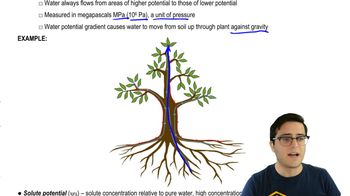
Understand the concept of water potential (Ψ), which is a measure of the potential energy in water and drives the movement of water. Water moves from areas of higher water potential to areas of lower water potential.
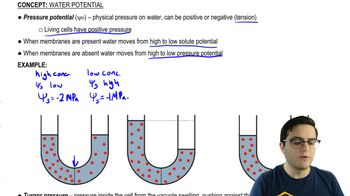
Recognize that the water potential of a solution is affected by solute concentration and pressure. The formula for water potential is Ψ = Ψs + Ψp, where Ψs is the solute potential and Ψp is the pressure potential.
Consider option a: Decreasing the Ψ of the surrounding solution would mean lowering its water potential, making it more negative. This would enhance water uptake by the plant cell because water would move from the higher water potential inside the cell to the lower water potential outside.
Evaluate option b: Positive pressure on the surrounding solution would increase the Ψp, potentially increasing the water potential of the surrounding solution, which might not enhance water uptake as water moves from higher to lower potential.
Analyze option c and d: The loss of solutes from the cell (option c) would increase the Ψs inside the cell, potentially reducing water uptake. Increasing the Ψ of the cytoplasm (option d) would make the water potential inside the cell higher, which would not enhance water uptake as water moves from higher to lower potential.

Verified video answer for a similar problem:

This video solution was recommended by our tutors as helpful for the problem above.
Video duration:
50s
Was this helpful?

Key Concepts

Here are the essential concepts you must grasp in order to answer the question correctly.

Water Potential (Ψ)

Water potential (Ψ) is a measure of the potential energy in water, influencing the direction of water movement. It is affected by solute concentration and pressure, with water moving from areas of higher to lower water potential. Understanding Ψ is crucial for determining how water uptake by plant cells is influenced by surrounding conditions.
Recommended video:
Guided course
11:32
Water Potential

Osmosis

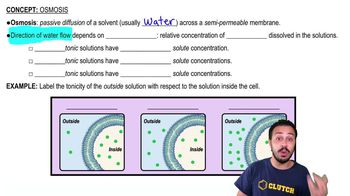
Osmosis is the passive movement of water across a semipermeable membrane from a region of lower solute concentration to higher solute concentration. In plant cells, osmosis drives water uptake, with water moving into cells when the external environment has a lower water potential than the cell's interior, facilitating nutrient absorption and cell turgor.
Recommended video:

Pressure Potential

Pressure potential is a component of water potential that accounts for the physical pressure exerted on water within plant cells. Positive pressure can increase water potential, promoting water movement into cells. Understanding how pressure potential interacts with solute concentration helps explain how external pressures can enhance or inhibit water uptake in plant cells.
Recommended video:
Guided course
11:58
Pressure Potential and Turgidity
Related Practice
Textbook Question

Which structure or compartment is part of the symplast?

a. The interior of a vessel element

b. The interior of a sieve tube

c. The cell wall of a mesophyll cell

d. An extracellular air space

1000
views
Textbook Question

Movement of phloem sap from a source to a sink

a. Occurs through the apoplast of sieve-tube elements

b. Depends ultimately on the activity of proton pumps

c. Depends on tension, or negative pressure potential

d. Results mainly from diffusion

1409
views
Textbook Question

Photosynthesis ceases when leaves wilt, mainly because

a. The chlorophyll in wilting leaves is degraded.

b. Accumulation of CO2 in the leaf inhibits enzymes.

c. Stomata close, preventing CO2 from entering the leaf.

d. Photolysis, the water-splitting step of photosynthesis, cannot occur when there is a water deficiency.

1698
views
Textbook Question

A plant cell with a ΨS of −0.65MPa maintains a constant volume when bathed in a solution that has a ΨS of −0.30MPa and is in an open container. The cell has a

a. ΨP of +0.65MPa

b. Ψ of −0.65MPa

c. ΨP of +0.35MPa

d. ΨP of 0 MPa

1083
views
Textbook Question

Compared with a cell with few aquaporin proteins in its membrane, a cell containing many aquaporin proteins will

a. Have a faster rate of osmosis

b. Have a lower water potential

c. Have a higher water potential

d. Accumulate water by active transport

1434
views
Textbook Question

Which of the following would tend to increase transpiration?

a. Spiny leaves

b. Sunken stomata

c. A thicker cuticle

d. Higher stomatal density

1703
views