Pearson+ LogoPearson+ Logo
Ch. 43 - The Immune System
Campbell - Campbell Biology 12th Edition
Urry12th EditionCampbell BiologyISBN: 9785794169850Not the one you use?Change textbook
Chapter 43, Problem 4

Which of the following statements is true?
a. An antibody has one antigen-binding site
b. A lymphocyte has receptors for a single antigen
c. Every antigen has a single epitope
d. A liver or muscle cell makes two classes of MHC molecule

Verified step by step guidance
1
Step 1: Understand the key terms in the question. An antibody is a protein produced by B cells that binds to specific antigens. Antigen-binding sites are regions on the antibody that interact with antigens. A lymphocyte is a type of white blood cell involved in immune responses, and MHC molecules are proteins on cell surfaces that present antigens to T cells.
Step 2: Analyze statement (a): 'An antibody has one antigen-binding site.' Recall that antibodies are Y-shaped molecules with two identical antigen-binding sites, one on each arm of the Y. This statement is false.
Step 3: Analyze statement (b): 'A lymphocyte has receptors for a single antigen.' Lymphocytes (B cells and T cells) are highly specific and typically have receptors that recognize only one specific antigen. This statement is true.
Step 4: Analyze statement (c): 'Every antigen has a single epitope.' An epitope is the specific part of an antigen that is recognized by the immune system. Most antigens have multiple epitopes, allowing them to interact with different antibodies or receptors. This statement is false.
Step 5: Analyze statement (d): 'A liver or muscle cell makes two classes of MHC molecule.' MHC molecules are classified into two types: MHC class I (present on all nucleated cells) and MHC class II (present on antigen-presenting cells like macrophages and dendritic cells). Liver and muscle cells typically express MHC class I but not MHC class II. This statement is false.

Verified video answer for a similar problem:

This video solution was recommended by our tutors as helpful for the problem above.
Video duration:
5m
Was this helpful?

Key Concepts

Here are the essential concepts you must grasp in order to answer the question correctly.

Antibodies and Antigen-Binding Sites

Antibodies are specialized proteins produced by B cells that recognize and bind to specific antigens. Each antibody typically has two identical antigen-binding sites, allowing it to bind to two identical epitopes on an antigen. This bivalent nature enhances the ability of antibodies to cross-link antigens, facilitating their neutralization and removal from the body.
Recommended video:
Guided course
06:16
Ribosomal tRNA Binding Sites

Lymphocyte Receptors

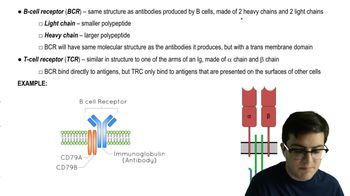
Lymphocytes, including B cells and T cells, express specific receptors that recognize particular antigens. Each lymphocyte is programmed to respond to a single antigen, which is determined by the unique structure of its receptors. This specificity is crucial for the adaptive immune response, allowing the immune system to target diverse pathogens effectively.
Recommended video:
Guided course
02:28
Intracellular Receptors

Epitopes and Antigens

An epitope is the specific part of an antigen that is recognized by the immune system, particularly by antibodies or T cell receptors. Antigens can have multiple epitopes, allowing them to elicit a diverse immune response. The presence of multiple epitopes on a single antigen enables the immune system to recognize and respond to various aspects of a pathogen.
Recommended video:
Guided course
03:50
Antigen Receptors