
Pearson+ LogoPearson+ Logo
Ch. 10 - Photosynthesis
Freeman - Biological Science 8th Edition
Freeman8th EditionBiological ScienceISBN: 9780138276263Not the one you use?Change textbook
Chapter 10, Problem 9b

Predict how the following conditions would affect the production of O2, ATP, and NADPH and state whether noncyclic or cyclic electron flow would occur in each:
(2) blue and red photons hit a chloroplast, but no NADP+ is available

Verified step by step guidance
1
Understand the role of NADP+ in photosynthesis: NADP+ is the final electron acceptor in the light-dependent reactions of photosynthesis. It is reduced to NADPH, which is then used in the Calvin cycle to synthesize glucose.
Recognize the impact of the absence of NADP+: Without NADP+, the electrons cannot be transferred to form NADPH. This disrupts the noncyclic electron flow, which typically results in the production of O2, ATP, and NADPH.
Consider the alternative pathway: In the absence of NADP+, the chloroplast may switch to cyclic electron flow. This process involves electrons cycling back to the photosystem, allowing ATP production but not NADPH or O2.
Analyze the effect on O2 production: Since O2 is produced during the splitting of water in noncyclic electron flow, the absence of NADP+ and the switch to cyclic flow would likely result in reduced or no O2 production.
Evaluate ATP production: Cyclic electron flow can still produce ATP because it involves the electron transport chain and proton gradient formation, but it does not produce NADPH or O2.

Verified video answer for a similar problem:

This video solution was recommended by our tutors as helpful for the problem above.
Video duration:
2m
Was this helpful?

Key Concepts

Here are the essential concepts you must grasp in order to answer the question correctly.

Photosynthesis and Light Reactions

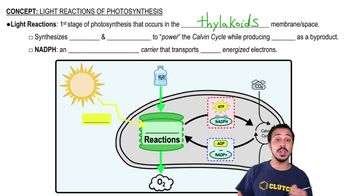
Photosynthesis is the process by which plants convert light energy into chemical energy. The light reactions occur in the thylakoid membranes of chloroplasts and involve the absorption of light by chlorophyll, leading to the production of ATP and NADPH. These reactions are driven by the absorption of specific wavelengths of light, primarily blue and red photons.
Recommended video:
Guided course
04:06
Light Reactions of Photosynthesis

Noncyclic and Cyclic Electron Flow

Noncyclic electron flow is the primary pathway in the light reactions, where electrons move from water to NADP+, producing NADPH and ATP, and releasing O2 as a byproduct. Cyclic electron flow, on the other hand, involves only photosystem I and results in the production of ATP without the generation of NADPH or O2. This pathway is utilized when NADP+ is not available to accept electrons.
Recommended video:
01:43
Gene Flow

Role of NADP+ in Photosynthesis

NADP+ is a crucial electron carrier in photosynthesis, acting as the final electron acceptor in the noncyclic electron flow. It is reduced to NADPH, which is then used in the Calvin cycle to synthesize glucose. When NADP+ is unavailable, the electron transport chain cannot proceed normally, leading to a shift towards cyclic electron flow to maintain ATP production without generating NADPH or O2.
Recommended video:
Guided course
05:58
Pigments of Photosynthesis
Related Practice
Textbook Question

Apply what you know of the relationship between the light-capturing reactions and the Calvin cycle to calculate the number of photons used to produce a new G3P and regenerate RuBP. (Assume 1 ATP is produced for each pair of electrons used to form NADPH.)

711
views
Textbook Question

Which of the following correctly identify a role of the ATP produced in the light-capturing reactions? Select True or False for each statement.

T/F It is used by rubisco to fix CO2 to RuBP.

T/F It serves the same role as ATP produced by mitochondria.

T/F It is used to regenerate RuBP from G3P molecules.

T/F It is used to produce G3P molecules

977
views
Textbook Question

Predict how the following conditions would affect the production of O2, ATP, and NADPH and state whether noncyclic or cyclic electron flow would occur in each:

(1) Only blue photons hit a chloroplast

761
views
Textbook Question

Predict how the following conditions would affect the production of O2, ATP, and NADPH and state whether noncyclic or cyclic electron flow would occur in each:

(3) blue and red photons hit a chloroplast, but a proton channel has been introduced into the thylakoid membrane, so it is fully permeable to protons.

1145
views
Textbook Question

An investigator exposes chloroplasts to 700-nm photons and observes low O2 production, but high ATP production. Which of the following best explains this observation?

a. The electrons from water are directly transferred to NADP+, which is used to generate ATP.

b. Photosystem II is not splitting water, and the ATP is being produced by cycling electrons via photosystem I.

c. The O2 is being converted to water as a terminal electron acceptor in the production of ATP.

d. Electron transport has stopped and ATP is being produced by the Calvin cycle.

1156
views