
The blending inheritance hypothesis proposed that the genetic material from parents is mixed in the offspring. As a result, traits of offspring and later descendants should lie between the phenotypes of parents. Mendel, in contrast, proposed that genes are discrete and that their integrity is maintained in the offspring and in subsequent generations. Suppose the year is 1890. You are a horse breeder who has just read Mendel's paper. You don't believe his results, however, because you often work with cremello (very light-colored) and chestnut (reddish-brown) horses. You know that when you breed a cremello individual from a pure-breeding line with a chestnut individual from a pure-breeding line, the offspring are palomino—meaning they have an intermediate (golden-yellow) body color. What additional cross would you do to test whether Mendel's model is valid in the case of genes for horse color? According to his model, what offspring phenotype frequencies would you get from your experimental cross? Explain why your cross would test Mendel's model versus blending inheritance.

- Ch. 1 - Biology: The Study of Life13
- Ch. 2 - Water and Carbon: The Chemical Basis of Life14
- Ch.3 - Protein Structure and Function10
- Ch.4 - Nucleic Acids and the RNA World10
- Ch. 5 - An Introduction to Carbohydrates10
- Ch. 6 - Lipids, Membranes, and the First Cells11
- Ch. 7 - Inside the Cell10
- Ch. 8 - Energy and Enzymes: An Introduction to Metabolism10
- Ch. 9 - Cellular Respiration and Fermentation11
- Ch. 10 - Photosynthesis12
- Ch. 11 - Cell-Cell Interactions12
- Ch. 12 - The Cell Cycle8
- Ch. 13 - Meiosis12
- Ch. 14 - Mendel and the Gene23
- Ch. 15 - DNA and the Gene: Synthesis and Repair15
- Ch. 16 - How Genes Work16
- Ch. 17 - Transcription, RNA Processing, and Translation16
- Ch. 18 - Control of Gene Expression in Bacteria16
- Ch. 19 - Control of Gene Expression in Eukaryotes12
- Ch. 20 - The Molecular Revolution: Biotechnology, Genomics, and New Frontiers15
- Ch. 21 - Genes, Development, and Evolution12
- Ch. 22 - Evolution by Natural Selection16
- Ch. 23 - Evolutionary Processes13
- Ch. 24 - Speciation15
- Ch. 25 - Phylogenies and the History of Life13
- Ch. 26 - Bacteria and Archaea15
- Ch. 27 - Diversification of Eukaryotes16
- Ch. 28 - Green Algae and Land Plants16
- Ch. 29 - Fungi18
- Ch. 30 - An Introduction to Animals9
- Ch. 31 - Protostome Animals15
- Ch. 32 - Deuterostome Animals17
- Ch. 33 - Viruses16
- Ch. 34 - Plant Form and Function16
- Ch. 35 - Water and Sugar Transport in Plants16
- Ch. 36 - Plant Nutrition13
- Ch. 37 - Plant Sensory Systems, Signals, and Responses16
- Ch. 38 - Flowering Plant Reproduction and Development16
- Ch. 39 - Animal Form and Function17
- Ch. 40 - Water and Electrolyte Balance in Animals16
- Ch. 41 - Animal Nutrition16
- Ch. 42 - Gas Exchange and Circulation16
- Ch. 43 - Animal Nervous Systems16
- Ch. 44 - Animal Sensory Systems16
- Ch. 45 - Animal Movement11
- Ch. 46 - Chemical Signals in Animals16
- Ch. 47 - Animal Reproduction and Development16
- Ch. 48 - The Immune System in Animals16
- Ch. 49 - An Introduction to Ecology15
- Ch. 50 - Behavioral Ecology16
- Ch. 51 - Population Ecology16
- Ch. 52 - Community Ecology20
- Ch. 53 - Ecosystems and Global Ecology17
- Ch. 54 - Biodiversity and Conservation Ecology18
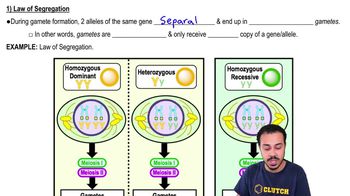
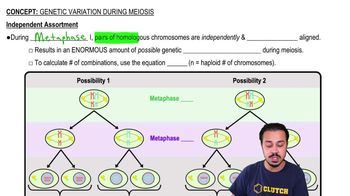
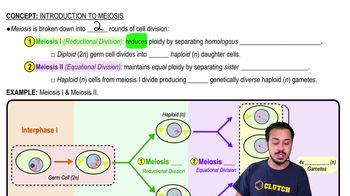
Suppose you are heterozygous for two genes that are located on different chromosomes. You carry alleles A and a for one gene and alleles B and b for the other. On the diagram, identify the events responsible for the principle of segregation and the principle of independent assortment.
 Verified step by step guidance
Verified video answer for a similar problem:

Key Concepts
Principle of Segregation
 03:24
03:24
Principle of Independent Assortment
 08:49
08:49Meiosis
 04:49
04:49Suppose you are heterozygous for two genes that are located on different chromosomes. You carry alleles A and a for one gene and alleles B and b for the other. Draw a diagram illustrating what happens to these genes and alleles when meiosis occurs in your reproductive tissues.
Suppose you are heterozygous for two genes that are located on different chromosomes. You carry alleles A and a for one gene and alleles B and b for the other. Be sure to list all the genetically different gametes that could form and indicate how frequently each type should be observed.
Suppose you are heterozygous for two genes that are located on different chromosomes. You carry alleles A and a for one gene and alleles B and b for the other. Label the stages of meiosis, the homologous chromosomes, sister chromatids, nonhomologous chromosomes, genes, and alleles.
Two mothers give birth to sons at the same time in a busy hospital. The son of couple 1 is afflicted with hemophilia A, which is a recessive X-linked disease. Neither parent has the disease. Couple 2 has a normal son even though the father has hemophilia A. The two couples sue the hospital in court, claiming that a careless staff member swapped their babies at birth. You appear in court as an expert witness. What do you tell the jury? Make a diagram that you can submit to the jury.
You have crossed two Drosophila melanogaster individuals that have long wings and red eyes—the wild-type phenotype. In the progeny, curved wings and lozenge eyes mutant phenotypes appear as follows According to these data, is the curved-wing allele autosomal recessive, autosomal dominant, sex-linked recessive, or sex-linked dominant?