Pearson+ LogoPearson+ Logo
Ch. 14 - Mendel and the Gene
Freeman - Biological Science 8th Edition
Freeman8th EditionBiological ScienceISBN: 9780138276263Not the one you use?Change textbook
Chapter 14, Problem 12a

Suppose you are heterozygous for two genes that are located on different chromosomes. You carry alleles A and a for one gene and alleles B and b for the other. Draw a diagram illustrating what happens to these genes and alleles when meiosis occurs in your reproductive tissues.

Verified step by step guidance
1
Start with a diploid cell containing homologous chromosomes for Gene 1 (A and a) and Gene 2 (B and b).
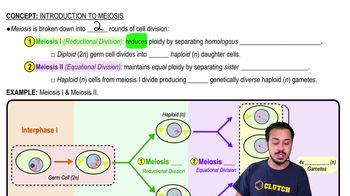
During Meiosis I, homologous chromosomes are separated into two different cells. Each cell will have one chromosome from each pair (e.g., one cell will have A and B, the other will have a and b).
In Meiosis II, the sister chromatids of each chromosome are separated into different cells.
This results in four haploid cells, each with one allele from each gene (e.g., AB, Ab, aB, ab).
These haploid cells can then participate in fertilization, combining with another haploid cell to form a diploid organism.

Verified video answer for a similar problem:

This video solution was recommended by our tutors as helpful for the problem above.
Video duration:
1m
Was this helpful?

Key Concepts

Here are the essential concepts you must grasp in order to answer the question correctly.

Meiosis

Meiosis is a specialized type of cell division that reduces the chromosome number by half, resulting in four haploid gametes. It consists of two sequential divisions: meiosis I and meiosis II. During meiosis I, homologous chromosomes are separated, while meiosis II separates sister chromatids. This process is crucial for sexual reproduction, ensuring genetic diversity through recombination and independent assortment.
Recommended video:
Guided course
04:49
Meiosis I & Meiosis II

Independent Assortment

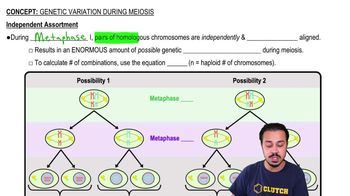
Independent assortment is a principle of genetics that states that alleles for different genes segregate independently of one another during gamete formation. This occurs during metaphase I of meiosis when homologous chromosome pairs align randomly at the cell's equator. As a result, the combination of alleles that end up in gametes is a mix of maternal and paternal genes, contributing to genetic variation in offspring.
Recommended video:
Guided course
08:49
Independent Assortment

Heterozygosity

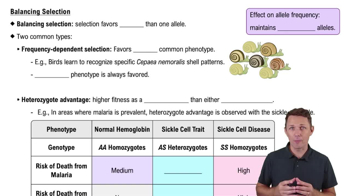
Heterozygosity refers to the presence of two different alleles at a specific gene locus on homologous chromosomes. In the context of the question, being heterozygous for genes A/a and B/b means that the individual carries one dominant and one recessive allele for each gene. This genetic variation is important for the expression of traits and can influence the phenotype of the organism, especially when considering dominant and recessive interactions.
Recommended video:
06:29
Balancing Selection
Related Practice
Textbook Question

In parakeets, two autosomal genes that are located on different chromosomes control the production of feather pigment. Gene B codes for an enzyme that is required for the synthesis of a blue pigment, and gene Y codes for an enzyme required for the synthesis of a yellow pigment. Green results from a mixture of yellow and blue pigments, and recessive mutations that prevent production of either pigment are known for both genes. Suppose that a breeder has two green parakeets and mates them. The offspring are green, blue, yellow, and albino (unpigmented).

Based on this observation, what are the genotypes of the green parents?

What genotypes produce each color in the offspring? What fraction of the progeny should exhibit each type of color?
845
views
Textbook Question

The smooth feathers on the back of the neck in pigeons can be reversed by a mutation to produce a 'crested' appearance in which feathers form a distinctive spike at the back of the head. A pigeon breeder examined offspring produced by a single pair of non-crested birds and recorded the following: 22 non-crested and 7 crested. She then made a series of crosses using offspring from the first cross. When she crossed two of the crested birds, all 20 of the offspring were crested. When she crossed a non-crested bird with a crested bird, 7 offspring were non-crested and 6 were crested. For these three crosses, provide genotypes for parents and offspring that are consistent with these results.

936
views
Textbook Question

The smooth feathers on the back of the neck in pigeons can be reversed by a mutation to produce a 'crested' appearance in which feathers form a distinctive spike at the back of the head. A pigeon breeder examined offspring produced by a single pair of non-crested birds and recorded the following: 22 non-crested and 7 crested. She then made a series of crosses using offspring from the first cross. When she crossed two of the crested birds, all 20 of the offspring were crested. When she crossed a non-crested bird with a crested bird, 7 offspring were non-crested and 6 were crested. Which allele is dominant?

937
views
Textbook Question

Suppose you are heterozygous for two genes that are located on different chromosomes. You carry alleles A and a for one gene and alleles B and b for the other. Label the stages of meiosis, the homologous chromosomes, sister chromatids, nonhomologous chromosomes, genes, and alleles.

913
views
Textbook Question

Suppose you are heterozygous for two genes that are located on different chromosomes. You carry alleles A and a for one gene and alleles B and b for the other. Be sure to list all the genetically different gametes that could form and indicate how frequently each type should be observed.

868
views
Textbook Question

Suppose you are heterozygous for two genes that are located on different chromosomes. You carry alleles A and a for one gene and alleles B and b for the other. On the diagram, identify the events responsible for the principle of segregation and the principle of independent assortment.

853
views