Pearson+ LogoPearson+ Logo
Ch. 15 - DNA and the Gene: Synthesis and Repair
Freeman - Biological Science 8th Edition
Freeman8th EditionBiological ScienceISBN: 9780138276263Not the one you use?Change textbook
Chapter 15, Problem 9

In the late 1950s, Herbert Taylor grew bean root-tip cells in a solution of radioactive thymidine (a precursor to one of the deoxyribonucleotides in DNA) and allowed them to undergo one round of DNA replication. He then transferred the cells to a solution without radioactive thymidine, allowed them to replicate again, and examined their chromosomes for the presence of radioactivity. His results are shown in the following figure, where red indicates a radioactive chromatid.
Diagram showing DNA replication stages: nonradioactive chromosome, radioactive chromatids, mitosis, and replication in nonradioactive solution.
(b) What would the results of Taylor's experiment be if eukaryotes used a conservative mode of DNA replication?

Verified step by step guidance
1
Understand the concept of DNA replication modes: In conservative replication, the original DNA molecule remains intact, and a completely new copy is made. In contrast, semi-conservative replication results in each new DNA molecule consisting of one original strand and one new strand.
Consider the experimental setup: Taylor's experiment involved growing cells in radioactive thymidine, which would incorporate into newly synthesized DNA strands during replication.
Analyze the first round of replication: If DNA replication were conservative, after the first round, one daughter DNA molecule would be entirely radioactive (newly synthesized) and the other would be non-radioactive (original).
Examine the second round of replication: In conservative replication, the original non-radioactive DNA would remain unchanged, and the radioactive DNA would produce a completely new non-radioactive copy. Thus, you would expect one pair of chromatids to be radioactive and the other pair to be non-radioactive.
Predict the experimental outcome: If eukaryotes used conservative replication, after two rounds of replication, you would observe one chromatid pair entirely radioactive and the other pair entirely non-radioactive, with no mixed chromatids.

Verified video answer for a similar problem:

This video solution was recommended by our tutors as helpful for the problem above.
Video duration:
1m
Was this helpful?

Key Concepts

Here are the essential concepts you must grasp in order to answer the question correctly.

DNA Replication

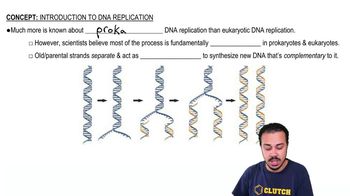
DNA replication is the process by which a cell duplicates its DNA, ensuring that each daughter cell receives an exact copy of the genetic material. It involves unwinding the double helix and using each strand as a template for synthesizing a new complementary strand. This process is crucial for cell division and is typically semi-conservative, meaning each new DNA molecule consists of one old and one new strand.
Recommended video:
Guided course
03:37
Introduction to DNA Replication

Semi-Conservative vs. Conservative Replication

In semi-conservative replication, each of the two resulting DNA molecules contains one original strand and one newly synthesized strand. In contrast, conservative replication would result in one molecule with two original strands and another with two new strands. Taylor's experiment demonstrated semi-conservative replication, as the presence of radioactivity in only one chromatid after the second replication cycle indicates that only one strand of each DNA molecule was newly synthesized.
Recommended video:
Guided course
03:56
Conservation Biology and Biodiversity

Radioactive Thymidine Labeling

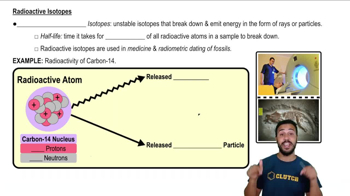
Radioactive thymidine is used to label newly synthesized DNA strands during replication. By incorporating this labeled nucleotide into DNA, researchers can track which strands are newly synthesized. In Taylor's experiment, the presence of radioactivity in chromatids after replication cycles helped determine the mode of DNA replication, as only newly synthesized strands would incorporate the radioactive label.
Recommended video:
Guided course
02:37
Radioactive Isotopes
Related Practice
Textbook Question

What aspect of DNA structure makes it possible for the proteins of nucleotide excision repair to recognize many different types of DNA damage?

(b) the antiparallel orientation of strands in the double helix

1626
views
Textbook Question

What aspect of DNA structure makes it possible for the proteins of nucleotide excision repair to recognize many different types of DNA damage?

(c) the energy differences between correct and incorrect base pairs

1427
views
Textbook Question

What aspect of DNA structure makes it possible for the proteins of nucleotide excision repair to recognize many different types of DNA damage?

(d) the regularity of DNA's structure

1585
views
Textbook Question

In the late 1950s, Herbert Taylor grew bean root-tip cells in a solution of radioactive thymidine (a precursor to one of the deoxyribonucleotides in DNA) and allowed them to undergo one round of DNA replication. He then transferred the cells to a solution without radioactive thymidine, allowed them to replicate again, and examined their chromosomes for the presence of radioactivity. His results are shown in the following figure, where red indicates a radioactive chromatid.

(a) Draw labeled diagrams of double-stranded DNA molecules that explain the pattern of radioactivity observed in the sister chromatids after the first and second rounds of replication.

722
views
Textbook Question

The graph that follows shows the survival of four different E. coli strains after exposure to increasing doses of ultraviolet light. The wild-type strain is normal, but the other strains have a mutation in either a gene called uvrA, a gene called recA, or both.

(a) Which strains are most sensitive to UV light? Which strains are least sensitive?

1518
views
Textbook Question

The graph that follows shows the survival of four different E. coli strains after exposure to increasing doses of ultraviolet light. The wild-type strain is normal, but the other strains have a mutation in either a gene called uvrA, a gene called recA, or both.

(b) What are the relative contributions of these genes to the repair of UV damage?

1619
views