Pearson+ LogoPearson+ Logo
Ch. 27 - Diversification of Eukaryotes
Freeman - Biological Science 8th Edition
Freeman8th EditionBiological ScienceISBN: 9780138276263Not the one you use?Change textbook
Chapter 27, Problem 7

Why was finding a close relationship between mitochondrial DNA and bacterial DNA considered particularly strong evidence in favor of the endosymbiosis theory?

Verified step by step guidance
1
Understand the endosymbiosis theory: This theory suggests that certain organelles, like mitochondria, originated as free-living bacteria that were engulfed by ancestral eukaryotic cells, forming a symbiotic relationship.
Explore the characteristics of mitochondrial DNA: Mitochondrial DNA is circular and resembles bacterial DNA, which is distinct from the linear DNA found in the nucleus of eukaryotic cells.
Examine the implications of DNA similarity: The similarity between mitochondrial DNA and bacterial DNA supports the idea that mitochondria evolved from bacteria, as they share structural and genetic features.
Consider the evolutionary significance: The presence of bacterial-like DNA in mitochondria suggests a common ancestry, reinforcing the concept that mitochondria were once independent organisms that became integrated into eukaryotic cells.
Evaluate the evidence for endosymbiosis: The close relationship between mitochondrial DNA and bacterial DNA provides strong molecular evidence for the endosymbiosis theory, as it indicates a historical symbiotic event leading to the evolution of complex eukaryotic cells.

Verified video answer for a similar problem:

This video solution was recommended by our tutors as helpful for the problem above.
Video duration:
3m
Was this helpful?

Key Concepts

Here are the essential concepts you must grasp in order to answer the question correctly.

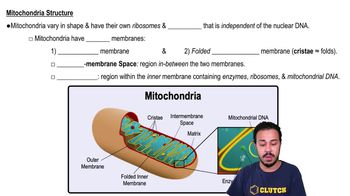
Mitochondrial DNA

Mitochondrial DNA (mtDNA) is the genetic material found in mitochondria, the energy-producing organelles within eukaryotic cells. Unlike nuclear DNA, mtDNA is circular and resembles bacterial DNA, supporting the idea that mitochondria originated from free-living bacteria. This similarity is crucial for understanding the evolutionary link proposed by the endosymbiosis theory.
Recommended video:
Guided course
04:45
Mitochondria Structure

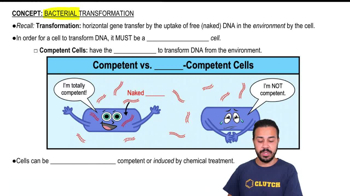
Bacterial DNA

Bacterial DNA is typically circular and not enclosed within a nucleus, differing from the linear DNA found in eukaryotic cells. The structural and genetic similarities between bacterial DNA and mitochondrial DNA provide evidence for the endosymbiosis theory, suggesting that mitochondria evolved from an ancestral symbiotic relationship with bacteria.
Recommended video:
Guided course
03:06
Bacterial Transformation

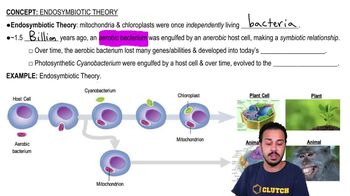
Endosymbiosis Theory

The endosymbiosis theory posits that certain organelles, like mitochondria and chloroplasts, originated as free-living bacteria that were engulfed by ancestral eukaryotic cells. Over time, these bacteria formed a symbiotic relationship, becoming integral parts of the host cell. The genetic similarities between mitochondrial and bacterial DNA strongly support this theory, indicating a shared evolutionary history.
Recommended video:
Guided course
06:58
Endosymbiotic Theory
Related Practice
Textbook Question

How can dinoflagellates be harmful to humans? a. They are transmitted by mosquitoes and cause malaria. b. They produce toxins that can be absorbed by clams and other shellfish which, when eaten by people, can lead to paralytic shellfish poisoning. c. They cause amoebic dysentery which leads to severe diarrhea and dehydration. d. They are transmitted by tsetse flies and cause 'sleeping sickness.'

551
views
Textbook Question

Explain the logic behind the claim that the nuclear envelope is a synapomorphy that defines eukaryotes as a monophyletic group.

657
views
Textbook Question

Consider the endosymbiosis theory for the origin of the mitochondrion. How did each endosymbiotic partner benefit from the relationship?

1623
views
1
rank
Textbook Question

The text claims that the evolutionary history of protists can be understood as a series of morphological innovations that established seven distinct lineages, each of which subsequently diversified based on innovative ways of feeding, moving, and reproducing. Explain how the Alveolata support this claim.

789
views
Textbook Question

Consider the following:

Plasmodium has an unusual organelle called an apicoplast. Recent research has shown that apicoplasts are derived from chloroplasts via secondary endosymbiosis and have a large number of genes related to chloroplast DNA.

Glyphosate is one of the most widely used herbicides. It works by poisoning an enzyme located in chloroplasts.

Biologists are testing the hypothesis that glyphosate could be used as an antimalarial drug in humans.

How are these observations connected?

622
views
Textbook Question

Suppose a friend says that we don't need to worry about the rising temperatures associated with global climate change. She claims that increased temperatures will make planktonic algae grow faster and that carbon dioxide (CO2) will be removed from the atmosphere faster. According to her, this carbon will be buried at the bottom of the ocean in calcium carbonate shells. As a result, the amount of carbon dioxide in the atmosphere will decrease and global warming will decline. Comment.

629
views