

Pearson+ LogoPearson+ Logo
Ch. 31 - Protostome Animals
Freeman - Biological Science 8th Edition
Freeman8th EditionBiological ScienceISBN: 9780138276263Not the one you use?Change textbook
Chapter 31, Problem 12b

A team of 102 scientists spent a year surveying a small area of the San Lorenzo rain forest in Panama to count the number of species of arthropods living there. After collecting 129,494 specimens—using nets, traps, shovels, tree-climbing harnesses, helium balloons, and other creative gear—it took the team eight years to sort and identify the arthropods. Rather than measuring the entire 6000-hectare (ha) forest, the researchers sampled arthropod diversity by intensively collecting as many arthropods as they could in 12 plots that measured 20 m × 20m square. If 1 ha=10,000 m², how many hectares of forest did they sample in all?
a. 20 m×20 m×12=4800 ha
b. 4800 m²×10,000 m²/1 ha=48,000,000 ha
c. 20 m×20 m=400 ha
d. 4800 m² x ha/10,000 m² = 0.48 ha

Verified step by step guidance
1
Step 1: Start by calculating the area of one plot. Each plot is a square with dimensions 20 m × 20 m. Use the formula for the area of a square: Area = side × side. This gives the area of one plot in square meters.
Step 2: Multiply the area of one plot by the total number of plots (12) to find the total area sampled in square meters. Use the formula: Total Area = Area of one plot × Number of plots.
Step 3: Convert the total area sampled from square meters to hectares. Recall that 1 hectare (ha) = 10,000 m². Use the conversion factor: Total Area in hectares = Total Area in square meters × (1 ha / 10,000 m²).
Step 4: Simplify the calculation by dividing the total area in square meters by 10,000 to get the total area in hectares.
Step 5: Verify the units in your final answer to ensure that the result is expressed in hectares (ha), which is the desired unit for the problem.

Verified video answer for a similar problem:

This video solution was recommended by our tutors as helpful for the problem above.
Video duration:
1m
Was this helpful?

Key Concepts

Here are the essential concepts you must grasp in order to answer the question correctly.

Area Calculation

To determine the total area sampled by the researchers, one must calculate the area of a single plot and then multiply it by the number of plots. Each plot measures 20 m by 20 m, which gives an area of 400 m². By multiplying this area by the 12 plots, the total sampled area can be found.
Recommended video:
Guided course
02:10
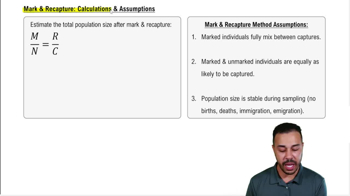
Mark & Recapture: Calculations & Assumptions

Unit Conversion

Understanding unit conversion is essential for translating the area from square meters to hectares. Since 1 hectare equals 10,000 square meters, converting the total area sampled from square meters to hectares involves dividing the area in square meters by 10,000.
Recommended video:
Guided course
05:05
Atoms- Smallest Unit of Matter

Sampling Methodology

The sampling methodology used by the scientists is crucial for understanding biodiversity assessments. By selecting specific plots within a larger area, researchers can estimate the diversity of species in the entire forest based on the data collected from these smaller, representative sections.
Recommended video:
Guided course
02:31
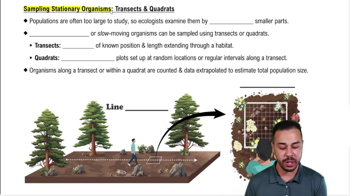
Sampling Stationary Organisms: Transects & Quadrats
Related Practice
Textbook Question

Evaluate this statement: Evolution is said to occur when new traits accumulate over time, increasing complexity.

639
views
Textbook Question

A team of 102 scientists spent a year surveying a small area of the San Lorenzo rain forest in Panama to count the number of species of arthropods living there. After collecting 129,494 specimens—using nets, traps, shovels, tree-climbing harnesses, helium balloons, and other creative gear—it took the team eight years to sort and identify the arthropods. Which of the following nested groups best describes the taxonomic context for the San Lorenzo project?

a. Animalia > Bilateria > Arthropoda > Ecdysozoa

b. Protostomia > Lophotrochozoa > Ecdysozoa > Arthropoda

c. Arthropoda > Protostomia > Ecdysozoa > Bilateria

d. Bilateria > Protostomia > Ecdysozoa > Arthropoda

736
views
Textbook Question

A team of 102 scientists spent a year surveying a small area of the San Lorenzo rain forest in Panama to count the number of species of arthropods living there. After collecting 129,494 specimens—using nets, traps, shovels, tree-climbing harnesses, helium balloons, and other creative gear—it took the team eight years to sort and identify the arthropods. The graph below shows some of the data for the major arthropod groups collected. Notice that the scale on the y-axis is logarithmic to make both small and large numbers legible on the same graph. For example, there are about 400 species of spiders but only 40 species of bees.

About how many arthropods were found in total?

About what percentage of these were beetles?

661
views
Textbook Question

A team of 102 scientists spent a year surveying a small area of the San Lorenzo rain forest in Panama to count the number of species of arthropods living there. After collecting 129,494 specimens—using nets, traps, shovels, tree-climbing harnesses, helium balloons, and other creative gear—it took the team eight years to sort and identify the arthropods. A team of 102 scientists spent a year surveying a small area of the San Lorenzo rain forest in Panama to count the number of species of arthropods living there. After collecting 129,494 specimens—using nets, traps, shovels, tree-climbing harnesses, helium balloons, and other creative gear—it took the team eight years to sort and identify the arthropods. Use the data in the graph to analyze the following statements.

Select True or False for each statement, then correct any false statements to make them true.

T/FAll taxa shown in the graph are insects.

T/FAll taxa shown in the graph have segmented bodies and limbs.

T/FAll taxa shown in the graph are terrestrial.

T/FIf the researchers had sampled for mollusks, they probably would have found almost as many species as they did for arthropods.

769
views
Textbook Question

A team of 102 scientists spent a year surveying a small area of the San Lorenzo rain forest in Panama to count the number of species of arthropods living there. After collecting 129,494 specimens—using nets, traps, shovels, tree-climbing harnesses, helium balloons, and other creative gear—it took the team eight years to sort and identify the arthropods. By comparing the number of arthropod species that were common among the 12 plots sampled, the researchers estimated that the total number of arthropods in the whole San Lorenzo forest is 25,000 species.

To come up with this estimate, what's one assumption the researchers had to make about the forest?

754
views