Pearson+ LogoPearson+ Logo
Ch. 33 - Viruses
Freeman - Biological Science 8th Edition
Freeman8th EditionBiological ScienceISBN: 9780138276263Not the one you use?Change textbook
Chapter 33, Problem 3

In the viral replicative cycle, what reaction do viral proteases catalyze?
Select True or False for each statement.
T/F They catalyze polymerization of amino acids into peptides.
T/F They catalyze folding of long peptide chains into functional proteins.
T/F They catalyze cutting of polyprotein chains into functional proteins.
T/F They catalyze breaking of peptide bonds

Verified step by step guidance
1
Understand the role of viral proteases: Viral proteases are enzymes that play a crucial role in the viral replicative cycle by processing viral polyproteins into functional proteins.
Examine the statement about polymerization: Viral proteases do not catalyze the polymerization of amino acids into peptides. This process is typically carried out by ribosomes during translation.
Consider the statement about folding: Folding of proteins into their functional forms is generally facilitated by chaperones, not proteases. Proteases are involved in cleaving peptide bonds.
Analyze the statement about cutting polyprotein chains: Viral proteases catalyze the cleavage of polyprotein chains into individual functional proteins, which is essential for viral maturation and replication.
Evaluate the statement about breaking peptide bonds: Viral proteases indeed catalyze the breaking of peptide bonds, specifically within polyprotein chains, to produce functional viral proteins.

Verified video answer for a similar problem:

This video solution was recommended by our tutors as helpful for the problem above.
Video duration:
51s
Was this helpful?

Key Concepts

Here are the essential concepts you must grasp in order to answer the question correctly.

Viral Proteases

Viral proteases are enzymes that play a crucial role in the viral life cycle by processing viral polyproteins into functional proteins. They achieve this by cleaving specific peptide bonds within the polyprotein, allowing the virus to mature and become infectious. Understanding their function is essential for comprehending how viruses replicate and how antiviral drugs can target these enzymes.
Recommended video:
Guided course
13:59
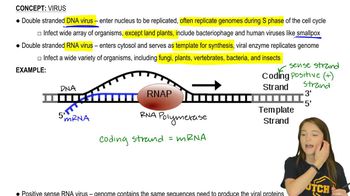
Viral Genetics

Polyprotein Processing

Polyprotein processing is a mechanism used by many viruses where a single, long polyprotein is synthesized and then cleaved into multiple functional proteins by viral proteases. This process is vital for the virus as it allows the production of various proteins from a single mRNA transcript, facilitating efficient use of the host's resources and ensuring proper viral assembly and replication.
Recommended video:
Guided course
04:19
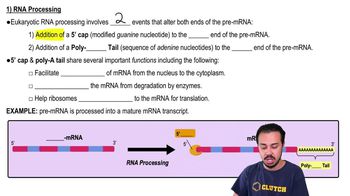
1) RNA Processing

Peptide Bond Cleavage

Peptide bond cleavage is the biochemical reaction catalyzed by proteases, including viral proteases, where the peptide bonds between amino acids in a protein or polyprotein are broken. This reaction is essential for converting inactive polyproteins into active, functional proteins, which are necessary for the virus to replicate and assemble new viral particles.
Recommended video:
Guided course
05:03
Hydrogen Bonding