Pearson+ LogoPearson+ Logo
Ch. 33 - Viruses
Freeman - Biological Science 8th Edition
Freeman8th EditionBiological ScienceISBN: 9780138276263Not the one you use?Change textbook
Chapter 33, Problem 1

What do host cells provide for viruses?
a. ATP
b. Nucleotides and amino acids
c. Ribosomes
d. All of the above

Verified step by step guidance
1
Understand the basic needs of viruses: Viruses are obligate intracellular parasites, meaning they require a host cell to replicate and perform their life cycle functions.
Consider the role of ATP: ATP is the energy currency of the cell, and viruses rely on the host cell's ATP to fuel their replication processes.
Examine the need for nucleotides and amino acids: Viruses use the host cell's nucleotides to synthesize their genetic material and amino acids to build viral proteins.
Evaluate the importance of ribosomes: Viruses do not have their own ribosomes, so they depend on the host cell's ribosomes to translate viral mRNA into proteins.
Conclude by considering all options: Since viruses require ATP, nucleotides, amino acids, and ribosomes from the host cell, the correct answer is likely 'd. all of the above'.

Verified video answer for a similar problem:

This video solution was recommended by our tutors as helpful for the problem above.
Video duration:
48s
Was this helpful?

Key Concepts

Here are the essential concepts you must grasp in order to answer the question correctly.

Virus Replication

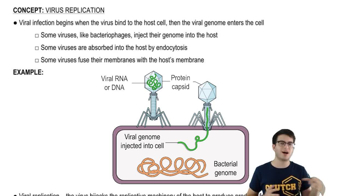
Viruses rely on host cells to replicate because they lack the necessary machinery to do so independently. They use the host's cellular machinery to synthesize viral components, including nucleic acids and proteins, which are essential for assembling new virus particles.
Recommended video:
Guided course
04:30
Virus Replication

Host Cell Resources

Host cells provide essential resources for viral replication, including ATP for energy, nucleotides for building viral RNA or DNA, and amino acids for constructing viral proteins. These resources are crucial for the virus to hijack the host's cellular processes and produce new virions.
Recommended video:
Guided course
03:57
Resource Partitioning (Partial Niche Overlap)

Ribosomes

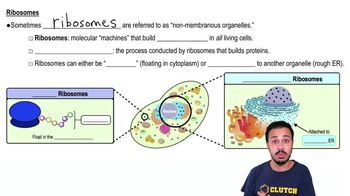
Ribosomes are cellular structures responsible for protein synthesis. Viruses depend on host cell ribosomes to translate viral mRNA into proteins, which are necessary for the virus's structure and function. Without access to ribosomes, viruses cannot produce the proteins required for their replication and assembly.
Recommended video: