
Pearson+ LogoPearson+ Logo
Ch. 36 - Plant Nutrition
Freeman - Biological Science 8th Edition
Freeman8th EditionBiological ScienceISBN: 9780138276263Not the one you use?Change textbook
Chapter 36, Problem 15d

The carnivorous plant Nepenthes bicalcarata ('fanged pitcher plant') has a unique relationship with a species of ant—Camponotus schmitzi ('diving ant'). The diving ants are not digested by the pitcher plants, but instead live on the plants and consume nectar. Diving ants also dive into the digestive juices in the pitcher, swim to the bottom, and capture and consume trapped insects, leaving uneaten body parts and ant feces behind.
What nutritional impact do the ants have on fanged pitcher plants?
Do the pitcher plants derive any nutritional benefit from this relationship?
Nitrogen is a key nutrient often obtained by carnivorous plants from the insects they digest. Are the results presented here what would be expected if nitrogen is a limiting nutrient? Explain.

Verified step by step guidance
1
Understand the mutualistic relationship: The fanged pitcher plant and the diving ant have a mutualistic relationship where both parties benefit. The ants get nectar and a habitat, while the plant potentially gains nutrients from the ants' activities.
Identify the role of ants: The diving ants consume trapped insects and leave behind uneaten body parts and feces. These remains can decompose and release nutrients, such as nitrogen, into the pitcher plant's digestive fluid.
Consider the nutritional impact: The decomposition of insect remains and ant feces can enrich the pitcher plant's environment with nitrogen, a crucial nutrient for plant growth, especially in nutrient-poor environments where these plants typically grow.
Evaluate the benefit to the plant: If nitrogen is a limiting nutrient, the presence of ants could enhance the plant's nitrogen intake, thus supporting its growth and survival. This mutualistic relationship can be particularly beneficial in nitrogen-deficient habitats.
Conclude on the expected results: Given that nitrogen is often a limiting nutrient for carnivorous plants, the presence of ants likely provides a significant nutritional benefit by increasing the nitrogen availability, which aligns with the expected outcome of such a mutualistic relationship.

Verified video answer for a similar problem:

This video solution was recommended by our tutors as helpful for the problem above.
Video duration:
1m
Was this helpful?

Key Concepts

Here are the essential concepts you must grasp in order to answer the question correctly.

Mutualistic Relationships

Mutualism is a type of symbiotic relationship where both species involved benefit from the interaction. In the case of Nepenthes bicalcarata and Camponotus schmitzi, the ants provide the plant with uneaten insect parts and feces, which can be a source of nutrients, while the plant offers nectar and a habitat for the ants. Understanding mutualism helps explain how both organisms can thrive together.
Recommended video:

Carnivorous Plant Nutrition

Carnivorous plants like Nepenthes bicalcarata typically obtain nutrients, especially nitrogen, from digesting trapped insects. This adaptation allows them to survive in nutrient-poor environments. The presence of ants may alter the nutrient acquisition strategy, potentially supplementing the plant's diet with additional nitrogen from ant feces and uneaten insect parts, which is crucial if nitrogen is a limiting nutrient.
Recommended video:
Guided course
10:21
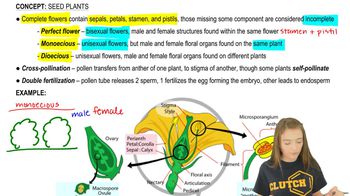
Seed Plants - 4

Nitrogen Limitation

Nitrogen is an essential nutrient for plant growth, often limiting in many ecosystems. Carnivorous plants have evolved to capture insects to supplement their nitrogen intake. If nitrogen is limiting, the presence of ants could provide an additional source of nitrogen through their waste and leftover insect parts, enhancing the plant's growth and survival in nutrient-poor conditions.
Recommended video:
Guided course
06:31
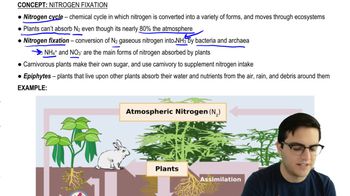
Nitrogen Cycle
Related Practice
Textbook Question

There is a conflict between van Helmont's data on willow tree growth and the data on essential nutrients listed in Table 36.1. According to the table, nutrients other than C, H, and O should make up about 4 percent of a willow tree's mass. Most or all of these nutrients should come from soil. But van Helmont claimed that the soil in his experiment lost just 60 g, while the tree gained 74,000 g. Calculate the percentage of the added mass accounted for by soil, and compare it to the predicted 4 percent. State at least one hypothesis to explain the conflict between expected and observed results. How would you test this hypothesis?

870
views
Textbook Question

Design an experiment, using radioactive carbon and the heavy isotope of nitrogen (15N2), that would test whether the Rhizobia–pea plant interaction is mutualistic.

852
views
Textbook Question

The carnivorous plant Nepenthes bicalcarata ('fanged pitcher plant') has a unique relationship with a species of ant—Camponotus schmitzi ('diving ant'). The diving ants are not digested by the pitcher plants, but instead live on the plants and consume nectar. Diving ants also dive into the digestive juices in the pitcher, swim to the bottom, and capture and consume trapped insects, leaving uneaten body parts and ant feces behind. What nutritional impact do the ants have on fanged pitcher plants? Do the pitcher plants derive any nutritional benefit from this relationship? Based only on the information provided here, make a prediction on the effect of diving ants on overall pitcher plant growth.

590
views
Textbook Question

The carnivorous plant Nepenthes bicalcarata ('fanged pitcher plant') has a unique relationship with a species of ant—Camponotus schmitzi ('diving ant'). The diving ants are not digested by the pitcher plants but instead live on the plants and consume nectar. Diving ants also dive into the digestive juices in the pitcher, swim to the bottom, and capture and consume trapped insects, leaving uneaten body parts and ant feces behind.

What nutritional impact do the ants have on fanged pitcher plants? Do the pitcher plants derive any nutritional benefit from this relationship?

Carnivorous plants and legumes (e.g., peas, soybeans) both absorb key nutrients directly from other organisms. How is nutrient acquisition in pitcher plants similar to that in legumes? How is it different?

738
views