
Pearson+ LogoPearson+ Logo
Ch. 38 - Flowering Plant Reproduction and Development
Freeman - Biological Science 8th Edition
Freeman8th EditionBiological ScienceISBN: 9780138276263Not the one you use?Change textbook
Chapter 38, Problem 14

Most flowering plants can achieve pollination in several different ways. Those that produce pollen and carpels on the same plant may be self-pollinated, but they may also be cross-pollinated by insects or other pollinators. The cape gooseberry (Physalis peruviana) shown here is able to produce seed whether it is self- or cross-pollinated.
Is one type of pollination better for reproductive success than the other?
In general, larger fruits tend to earn higher profits for farmers who grow cape gooseberries as a crop.
Compared to self-pollinated flowers, what is the approximate percentage of difference in fruit size of bee-pollinated flowers?

Verified step by step guidance
1
Understand the types of pollination: Self-pollination occurs when pollen from the same plant fertilizes its own ovules, while cross-pollination involves pollen from one plant fertilizing the ovules of another plant, often facilitated by pollinators like bees.
Identify the key variable: The problem is asking for the percentage difference in fruit size between self-pollinated and bee-pollinated flowers.
Gather data: You would need data on the average fruit size from self-pollinated flowers and bee-pollinated flowers. This could be obtained from experimental results or studies on Physalis peruviana.
Calculate the percentage difference: Use the formula for percentage difference: \( \text{Percentage Difference} = \frac{\text{Size of Bee-pollinated Fruit} - \text{Size of Self-pollinated Fruit}}{\text{Size of Self-pollinated Fruit}} \times 100 \).
Interpret the results: Once you have calculated the percentage difference, consider the implications for reproductive success and agricultural profitability, as larger fruits tend to be more profitable for farmers.

Verified video answer for a similar problem:

This video solution was recommended by our tutors as helpful for the problem above.
Video duration:
47s
Was this helpful?

Key Concepts

Here are the essential concepts you must grasp in order to answer the question correctly.

Pollination Types

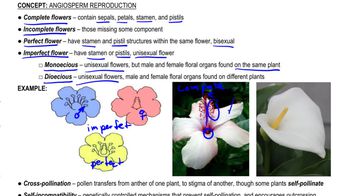
Pollination is the process by which pollen is transferred from the male part of a flower (anther) to the female part (stigma). There are two main types: self-pollination, where pollen from the same plant fertilizes the ovules, and cross-pollination, where pollen is transferred between different plants, often by wind or pollinators like bees. Cross-pollination generally increases genetic diversity, which can lead to more robust plant populations.
Recommended video:

Reproductive Success in Plants

Reproductive success in plants refers to the ability to produce viable offspring that can survive and reproduce. This success can be influenced by the type of pollination. Cross-pollination often results in greater genetic variation, which can enhance adaptability and survival, potentially leading to larger and more viable fruits, which are economically beneficial for crops like cape gooseberries.
Recommended video:
Guided course
09:27
Fungi Reproduction - 1

Impact of Pollination on Fruit Size

The size of the fruit can be influenced by the type of pollination. Cross-pollination, especially by bees, can lead to larger fruits due to better fertilization and genetic diversity. Larger fruits are often more desirable in agriculture as they can yield higher profits. Understanding the percentage difference in fruit size between self-pollinated and bee-pollinated flowers can help farmers optimize their crop yields.
Recommended video:
Guided course
03:35
Geographic Impact on Communities
Related Practice
Textbook Question

Most flowering plants can achieve pollination in several different ways. Those that produce pollen and carpels on the same plant may be self-pollinated, but they may also be cross-pollinated by insects or other pollinators. The cape gooseberry (Physalis peruviana) shown here is able to produce seed whether it is self- or cross-pollinated.

Is one type of pollination better for reproductive success than the other?

Considering the gooseberry flower shown here, what types of cues might attract bees to the plant?

What type of rewards do bees seek?

1206
views
Textbook Question

Most flowering plants can achieve pollination in several different ways. Those that produce pollen and carpels on the same plant may be self-pollinated, but they may also be cross-pollinated by insects or other pollinators. The cape gooseberry (Physalis peruviana) shown here is able to produce seed whether it is self- or cross-pollinated.

Is one type of pollination better for reproductive success than the other?

Researchers conducted controlled experiments to test for effects of different types of pollination on cape gooseberry fruit size and seed production. The types of pollination included self-pollination, cross-pollination by bees, and manual cross-pollination (transferring pollen from one plant to another by hand). Results are shown in the graphs here. Compared to self-pollination, do bees have a significant impact on fruit mass?

How about on seed formation?

1221
views
Textbook Question

Most flowering plants can achieve pollination in several different ways. Those that produce pollen and carpels on the same plant may be self-pollinated, but they may also be cross-pollinated by insects or other pollinators. The cape gooseberry (Physalis peruviana) shown here is able to produce seed whether it is self- or cross-pollinated.

Is one type of pollination better for reproductive success than the other?

Why might it be advantageous for plants to promote cross-pollination?

What are the advantages of self-pollination?

925
views
Textbook Question

Most flowering plants can achieve pollination in several different ways. Those that produce pollen and carpels on the same plant may be self-pollinated, but they may also be cross-pollinated by insects or other pollinators. The cape gooseberry (Physalis peruviana) shown here is able to produce seed whether it is self- or cross-pollinated.

Is one type of pollination better for reproductive success than the other?

Based on the data in the graphs provided, approximately how many ovules are found in each gooseberry carpel?

1001
views
Textbook Question

Most flowering plants can achieve pollination in several different ways. Those that produce pollen and carpels on the same plant may be self-pollinated, but they may also be cross-pollinated by insects or other pollinators. The cape gooseberry (Physalis peruviana) shown here is able to produce seed whether it is self- or cross-pollinated.

Is one type of pollination better for reproductive success than the other?

Global bee populations have been declining over the past decade.

What impact might this have on the world's human population?

741
views