Pearson+ LogoPearson+ Logo
Ch. 40 - Water and Electrolyte Balance in Animals
Freeman - Biological Science 8th Edition
Freeman8th EditionBiological ScienceISBN: 9780138276263Not the one you use?Change textbook
Chapter 40, Problem 9

Biologists have been able to produce mice that lack functioning genes for aquaporins. How would the urine of these mice compare to that of mice with normal aquaporins?
a. Lower volume and lower osmolarity
b. Lower volume and higher osmolarity
c. Higher volume and lower osmolarity
d. Higher volume and higher osmolarity

Verified step by step guidance
1
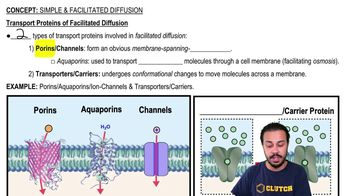
Understand the role of aquaporins: Aquaporins are membrane proteins that facilitate the transport of water across cell membranes. They are crucial for maintaining water balance in cells and tissues.
Consider the effect of lacking aquaporins: Without functioning aquaporins, the ability of cells, particularly in the kidneys, to reabsorb water is impaired. This means that more water remains in the urine, leading to changes in urine volume and concentration.
Analyze urine volume: Mice lacking aquaporins would likely produce urine with a higher volume because less water is reabsorbed back into the body from the urine.
Analyze urine osmolarity: With less water reabsorption, the urine would be less concentrated, leading to lower osmolarity. Osmolarity refers to the concentration of solutes in the urine.
Combine the effects: Based on the analysis, the urine of mice lacking aquaporins would have a higher volume and lower osmolarity compared to mice with normal aquaporins.

Verified video answer for a similar problem:

This video solution was recommended by our tutors as helpful for the problem above.
Video duration:
2m
Was this helpful?

Key Concepts

Here are the essential concepts you must grasp in order to answer the question correctly.

Aquaporins

Aquaporins are integral membrane proteins that serve as channels for water transport across cell membranes. They play a crucial role in maintaining water homeostasis in organisms by facilitating rapid and selective water movement. In the kidneys, aquaporins are essential for concentrating urine and regulating its volume and osmolarity.
Recommended video:
Guided course
04:49
Transport Proteins of Facilitated Diffusion

Urine Osmolarity

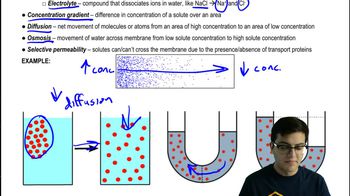
Urine osmolarity refers to the concentration of solutes in urine, which is a measure of its ability to concentrate or dilute. It is influenced by the kidney's ability to reabsorb water and solutes, a process heavily dependent on aquaporins. In the absence of functioning aquaporins, urine osmolarity is likely to be higher due to reduced water reabsorption.
Recommended video:
Guided course
07:59
Osmosis and Osmolarity

Water Reabsorption in Kidneys

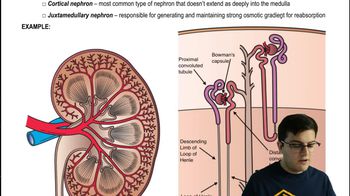
Water reabsorption in the kidneys is a critical process for maintaining body fluid balance and is primarily facilitated by aquaporins in the renal tubules. Without aquaporins, the kidneys cannot efficiently reabsorb water, leading to increased urine volume and altered osmolarity. This process is vital for understanding how genetic modifications affecting aquaporins impact urine characteristics.
Recommended video:
Guided course
02:59
Kidney and Nephron
Related Practice
Textbook Question

The chloride cells of fish gills have a high density of mitochondria. How does this characteristic relate to the functional role of chloride cells?

Would you expect other epithelial cells involved in ion transport to contain large numbers of mitochondria? Explain.

1252
views
Textbook Question

Explain why mammals would not be able to produce concentrated urine if their nephrons lacked loops of Henle.

926
views
Textbook Question

Scientists have noted that marine invertebrates tend to be osmoconformers, while freshwater invertebrates tend to be osmoregulators. Suggest an explanation for this phenomenon.

1039
views
Textbook Question

To test the hypothesis that mussels are osmoconformers, researchers exposed mussels to water of varying osmolarities and then drew hemolymph samples from the mussels. Graph the data provided here. Put the independent variable on the x-axis and the dependent variable on the y-axis.

Is the researchers' hypothesis supported by the data? Explain.

676
views
Textbook Question

Fish and other aquatic organisms are exposed to many types of water pollutants, including metals such as aluminum. Although a low level of aluminum is found in unpolluted water, many lakes and streams have an increased level because of mining, sewage treatment, and accidental spills of toxic materials. Aluminum pollution can result in mass fish die-offs such as the one pictured here. How does this occur? Which of the following is an osmoregulatory challenge that freshwater fishes need to overcome?

a. Diffusion of sodium ions out of the body

b. Diffusion of water out of the body

c. Active transport of sodium ions out of the body

d. Active transport of water out of the body

799
views
Textbook Question

Fish and other aquatic organisms are exposed to many types of water pollutants, including metals such as aluminum. Although a low level of aluminum is found in unpolluted water, many lakes and streams have an increased level because of mining, sewage treatment, and accidental spills of toxic materials. Aluminum pollution can result in mass fish die-offs. In a laboratory, scientists exposed freshwater bony fish (Prochilodus lineatus) to water with a high level of aluminum and compared their blood osmolarity to that of fish exposed to water with a normal aluminum level (control). The results of the experiment are shown here (asterisks indicate P<0.05 between control and treated groups at a given time).

Do the data support the hypothesis that aluminum interferes with osmoregulation in freshwater fishes? Explain.

629
views