Pearson+ LogoPearson+ Logo
Ch. 40 - Water and Electrolyte Balance in Animals
Freeman - Biological Science 8th Edition
Freeman8th EditionBiological ScienceISBN: 9780138276263Not the one you use?Change textbook
Chapter 40, Problem 3

What effect does antidiuretic hormone (ADH) have on the nephron?
a. It increases the water permeability of the descending limb of the loop of Henle.
b. It decreases the water permeability of the descending limb of the loop of Henle.
c. It increases the water permeability of the collecting duct.
d. It decreases the water permeability of the collecting duct.

Verified step by step guidance
1
Understand the role of antidiuretic hormone (ADH) in the body: ADH is a hormone that helps regulate water balance by increasing water reabsorption in the kidneys.
Identify the parts of the nephron involved in water reabsorption: The nephron includes structures such as the loop of Henle and the collecting duct, which play roles in concentrating urine and reabsorbing water.
Focus on the collecting duct: ADH primarily affects the collecting duct, where it increases the permeability of the duct to water, allowing more water to be reabsorbed back into the bloodstream.
Consider the options given: Options a and b refer to the loop of Henle, which is not the primary site of ADH action. Options c and d refer to the collecting duct, which is the correct site of ADH action.
Determine the correct effect of ADH: ADH increases water permeability in the collecting duct, allowing more water to be reabsorbed, which corresponds to option c.

Verified video answer for a similar problem:

This video solution was recommended by our tutors as helpful for the problem above.
Video duration:
1m
Was this helpful?

Key Concepts

Here are the essential concepts you must grasp in order to answer the question correctly.

Antidiuretic Hormone (ADH)

Antidiuretic hormone (ADH), also known as vasopressin, is a hormone produced by the hypothalamus and released by the posterior pituitary gland. Its primary role is to regulate water balance in the body by controlling the amount of water reabsorbed by the kidneys. ADH increases the permeability of the kidney's collecting ducts to water, allowing more water to be reabsorbed back into the bloodstream, thus concentrating the urine and reducing urine volume.
Recommended video:
Guided course
08:18
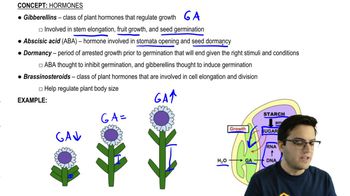
Plant Hormones and Senescence

Nephron Structure

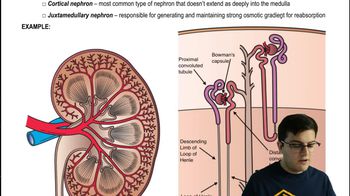
The nephron is the functional unit of the kidney, responsible for filtering blood and forming urine. It consists of several parts, including the glomerulus, proximal tubule, loop of Henle, distal tubule, and collecting duct. Each segment has specific functions in the process of urine formation, such as filtration, reabsorption, and secretion. Understanding the role of each part, particularly the collecting duct, is crucial for comprehending how ADH affects water reabsorption.
Recommended video:
Guided course
02:59
Kidney and Nephron

Water Permeability in the Collecting Duct

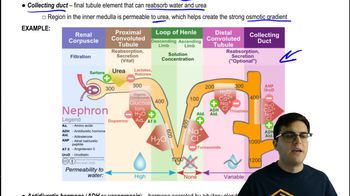
Water permeability in the collecting duct is a key factor in the kidney's ability to concentrate urine. Under the influence of ADH, aquaporin channels are inserted into the membrane of the collecting duct cells, increasing their permeability to water. This allows more water to be reabsorbed from the filtrate back into the bloodstream, thereby concentrating the urine and conserving water in the body. This process is essential for maintaining fluid balance and preventing dehydration.
Recommended video:
Guided course
04:08
Distal Tubule and Collecting Duct
Related Practice
Textbook Question

Which of the following statements regarding fishes that live in fresh-water is/are correct? Select True or False for each statement.

T/F Water moves across the gills via osmosis until equilibrium is established, at which time the water molecules stop moving.

T/F They lose water to their environment primarily through the gills. They replace this water by drinking.

T/F Water enters epithelial cells in their gills via osmosis. Electrolytes leave the same cells via diffusion.

T/F They have specialized epithelia that actively pump electrolytes from the environment into the blood.

532
views
Textbook Question

Which of the following organisms would lose the most water by osmosis across its gills?

a. Marine bony fish

b. Shark

c. Freshwater fish

d. Freshwater invertebrate

1103
views
Textbook Question

In Gila monsters, the organ in which water from urine is reabsorbed into the bloodstream is the___________.             .

536
views
Textbook Question

Compare and contrast the types of nitrogenous wastes excreted by animals. Identify which type can be excreted with the least water, which is most toxic, and which waste is excreted by bony fishes, by mammals, and by insects. Which type would you expect to be produced by embryos inside eggs laid on land?

1493
views
Textbook Question

The chloride cells of fish gills have a high density of mitochondria. How does this characteristic relate to the functional role of chloride cells?

Would you expect other epithelial cells involved in ion transport to contain large numbers of mitochondria? Explain.

1252
views