
Pearson+ LogoPearson+ Logo
Ch. 49 - An Introduction to Ecology
Freeman - Biological Science 8th Edition
Freeman8th EditionBiological ScienceISBN: 9780138276263Not the one you use?Change textbook
Chapter 49, Problem 2

Where do rain shadows exist?
a. The part of a mountain that receives prevailing winds and heavy rain
b. The region beyond a mountain range that receives dry air
c. The region along the equator where precipitation is abundant
d. The region near 30°N and 30°S latitude that receives dry air

Verified step by step guidance
1
Understand the concept of a rain shadow: A rain shadow is a dry area on the leeward side of a mountainous area. Mountains block the passage of rain-producing weather systems and cast a 'shadow' of dryness behind them.
Identify the process: When moist air rises over a mountain, it cools and loses moisture as precipitation on the windward side. As the air descends on the leeward side, it warms and dries, creating a rain shadow.
Analyze the options: Option a describes the windward side of a mountain, which is not a rain shadow. Option c describes the equatorial region, which is not related to rain shadows. Option d describes regions at 30°N and 30°S, which are typically dry but not due to rain shadows.
Focus on option b: The region beyond a mountain range that receives dry air is the leeward side, where rain shadows exist due to the drying effect of descending air.
Conclude that option b is the correct description of where rain shadows exist, as it accurately describes the leeward side of a mountain range.

Verified video answer for a similar problem:

This video solution was recommended by our tutors as helpful for the problem above.
Video duration:
1m
Was this helpful?

Key Concepts

Here are the essential concepts you must grasp in order to answer the question correctly.

Rain Shadow Effect

The rain shadow effect occurs when moist air ascends a mountain range, cools, and releases precipitation on the windward side. As the air descends on the leeward side, it becomes dry, creating a rain shadow region. This phenomenon explains why areas beyond mountain ranges often receive less rainfall.
Recommended video:
Guided course
04:52
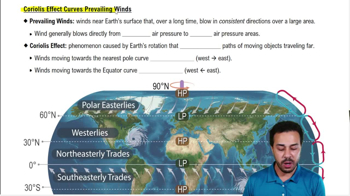
Coriolis Effect Curves Prevailing Winds

Prevailing Winds

Prevailing winds are consistent wind patterns that occur due to the Earth's rotation and atmospheric circulation. These winds play a crucial role in weather patterns, including the distribution of moisture and the formation of rain shadows, as they carry moist air towards mountain ranges.
Recommended video:
Guided course
04:52
Coriolis Effect Curves Prevailing Winds

Geographical Influence on Climate

Geographical features like mountains significantly influence local climate by altering wind and precipitation patterns. Mountains can block moist air, leading to dry conditions on their leeward side, known as the rain shadow area, affecting the climate and ecosystem of the region.
Recommended video:
Guided course
03:35
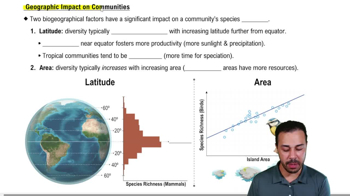
Geographic Impact on Communities