
Pearson+ LogoPearson+ Logo
Ch. 51 - Population Ecology
Freeman - Biological Science 8th Edition
Freeman8th EditionBiological ScienceISBN: 9780138276263Not the one you use?Change textbook
Chapter 51, Problem 5

Which of the following species is most likely to have a Type III survivorship curve?
a. Humans, Homo sapiens
b. Common lizards, Zootoca vivipara
c. Thale cress plants, Arabidopsis thaliana
d. Lynx cats, Lynx canadensis

Verified step by step guidance
1
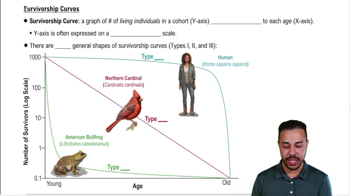
Understand the concept of a Type III survivorship curve: This curve is characterized by high mortality rates for the young, with a much lower mortality rate for individuals who survive past a certain age. Species with this type of curve often produce a large number of offspring, but few survive to adulthood.
Consider the reproductive strategies of each species: Species with Type III survivorship curves typically produce many offspring with little parental care, relying on the sheer number of offspring to ensure that some survive.
Analyze the species options: Humans (Homo sapiens) typically have a Type I curve with low infant mortality and high parental care. Common lizards (Zootoca vivipara) may have a Type II curve with relatively constant mortality rates. Lynx cats (Lynx canadensis) also tend to have a Type I or II curve due to parental care.
Focus on thale cress plants (Arabidopsis thaliana): These plants produce many seeds, and most do not survive to maturity, fitting the Type III survivorship curve pattern.
Conclude that thale cress plants (Arabidopsis thaliana) are most likely to have a Type III survivorship curve due to their reproductive strategy and high juvenile mortality.

Verified video answer for a similar problem:

This video solution was recommended by our tutors as helpful for the problem above.
Video duration:
1m
Was this helpful?

Key Concepts

Here are the essential concepts you must grasp in order to answer the question correctly.

Survivorship Curves

Survivorship curves are graphical representations that show the number of individuals in a population that survive to different ages. There are three types: Type I, where most individuals live to old age (e.g., humans); Type II, where the chance of survival is independent of age; and Type III, where most individuals die young, with few surviving to adulthood (e.g., many plants and fish).
Recommended video:
Guided course
02:54
Survivorship Curves

Type III Survivorship Curve

A Type III survivorship curve is characterized by high mortality rates for the young, with a few individuals surviving to adulthood. This pattern is common in species that produce a large number of offspring but provide little or no parental care, such as many plants, fish, and invertebrates. The strategy is to produce many offspring to ensure that at least some survive to reproduce.
Recommended video:
Guided course
02:54
Survivorship Curves

Life History Strategies

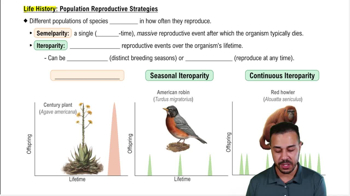
Life history strategies refer to the overall pattern in average timing and nature of life cycle events, shaped by natural selection to produce the largest possible number of surviving offspring. Species with a Type III survivorship curve often have an r-selected strategy, focusing on high reproductive rates, early maturity, and producing many offspring, which increases the chance of some surviving in unpredictable environments.
Recommended video:
Guided course
02:51
Life History: Population Reproductive Strategies