
Pearson+ LogoPearson+ Logo
Ch. 51 - Population Ecology
Freeman - Biological Science 8th Edition
Freeman8th EditionBiological ScienceISBN: 9780138276263Not the one you use?Change textbook
Chapter 51, Problem 8

Indicate what is correct and incorrect about this statement: If lizards want to survive during climate change, they can evolve new life-history traits.

Verified step by step guidance
1
Step 1: Understand the statement. The statement suggests that lizards can evolve new life-history traits to survive during climate change.
Step 2: Identify the correct part of the statement. It is true that organisms, including lizards, can evolve new traits over time in response to environmental changes. This is a fundamental concept in evolutionary biology.
Step 3: Identify the incorrect part of the statement. The incorrect part is the implication that lizards, or any organisms, can 'want' to evolve or consciously control their evolution. Evolution is a natural process driven by genetic variation and natural selection, not by the desires or intentions of organisms.
Step 4: Understand the concept of evolution. Evolution is a process that occurs over many generations, and it's not something that an individual organism can do during its lifetime. It's a population-level phenomenon.
Step 5: Understand the concept of life-history traits. Life-history traits are characteristics that affect an organism's schedule and manner of reproduction. These traits can evolve over time in response to environmental pressures, but again, this is not a process that individual organisms can consciously control.

Verified video answer for a similar problem:

This video solution was recommended by our tutors as helpful for the problem above.
Video duration:
1m
Was this helpful?

Key Concepts

Here are the essential concepts you must grasp in order to answer the question correctly.

Evolution

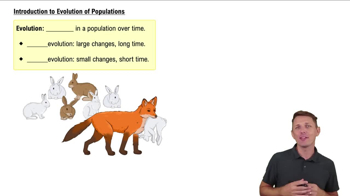
Evolution is the process through which species change over time through variations in traits that are passed down through generations. Natural selection plays a crucial role, as individuals with advantageous traits are more likely to survive and reproduce. However, evolution occurs over long timescales, making immediate adaptation to rapid environmental changes, like climate change, challenging.
Recommended video:
05:14
Introduction to Evolution of Populations

Life-history Traits

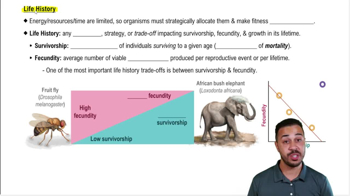
Life-history traits refer to the biological characteristics of an organism that influence its reproductive success and survival, such as age at first reproduction, number of offspring, and lifespan. These traits are shaped by evolutionary pressures and can vary significantly among species. Changes in life-history traits can be a response to environmental factors, but such changes typically require multiple generations.
Recommended video:

Phenotypic Plasticity

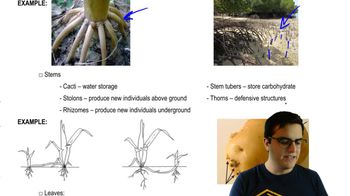
Phenotypic plasticity is the ability of an organism to change its phenotype in response to environmental conditions. This adaptability allows species to survive in varying environments without genetic changes. For lizards facing climate change, phenotypic plasticity may enable them to adjust behaviors or physiological traits quickly, but it does not equate to evolutionary changes in life-history traits.
Recommended video:
Guided course
06:58
Phenotypic Plasticity
Related Practice
Textbook Question

Which of the following species is most likely to have a Type III survivorship curve?

a. Humans, Homo sapiens

b. Common lizards, Zootoca vivipara

c. Thale cress plants, Arabidopsis thaliana

d. Lynx cats, Lynx canadensis

1163
views
Textbook Question

Pose a hypothesis to explain why the human population has undergone especially rapid growth over the past 200 years. Describe two examples of density-dependent factors that limit human population growth. Is it possible that humans have surpassed Earth's carrying capacity?

810
views
Textbook Question

Explain why biologists want to maintain (a) 'habitat corridors' that connect populations in a metapopulation, and (b) unoccupied habitat that is appropriate for the species in question.

740
views
Textbook Question

When wild plant and animal populations are logged, fished, or hunted, only the oldest or largest individuals tend to be taken. Many of the commercially important species are long lived and are slow to begin reproducing. If harvesting is not regulated carefully and exploitation is intense, what impact does harvesting have on a population's age structure? How might harvesting affect the population's life table and growth rate?

1076
views
Textbook Question

Burmese pythons (Python molurus bivittatus) are constricting snakes that can reach enormous sizes (up to 7 meters in length). They are native to Southeast Asia but were released into southern Florida from the pet trade. Many other snakes occur naturally in this area. Are the introduced pythons a problem? Burmese pythons were first found in the wetlands of Everglades National Park in the 1980s, but only rarely. The accompanying graph shows what happened next. Most of the data are derived from chance encounters of pythons on roads and intermittent search effort near roads (pythons are notoriously difficult to find). Despite the variability in search effort, what type of population growth best describes the trend in the data from 2000 to 2020? a. logistic b. exponential c. linear d. logarithmic


250
views