
Do you drink coffee? A lot of people do—coffee is a major tropical crop, valued at over \$100 billion per year. The most popular species of coffee, Coffea arabica, originated in Africa and is now planted extensively in Central and South America. The pest called the coffee berry borer beetle (Hypothenemus hampeii) moved along with the coffee and is a major problem for coffee farmers, sometimes destroying half of the coffee crop in mature plantations. Draw a simple model to compare the relative species richness and species diversity of these two coffee plantations: one is clear-cut and planted with only coffee shrubs, the other retains some natural forest. For symbols, use a few letters to represent different species of plants and a few numbers to represent different species of animals in a square 1-ha plot.
Ch. 54 - Biodiversity and Conservation Ecology

Freeman8th EditionBiological ScienceISBN: 9780138276263
Not the one you use?Change textbookSelect a different textbook
Table of contents
- Ch. 1 - Biology: The Study of Life13
- Ch. 2 - Water and Carbon: The Chemical Basis of Life14
- Ch.3 - Protein Structure and Function10
- Ch.4 - Nucleic Acids and the RNA World10
- Ch. 5 - An Introduction to Carbohydrates10
- Ch. 6 - Lipids, Membranes, and the First Cells11
- Ch. 7 - Inside the Cell10
- Ch. 8 - Energy and Enzymes: An Introduction to Metabolism10
- Ch. 9 - Cellular Respiration and Fermentation11
- Ch. 10 - Photosynthesis12
- Ch. 11 - Cell-Cell Interactions12
- Ch. 12 - The Cell Cycle8
- Ch. 13 - Meiosis12
- Ch. 14 - Mendel and the Gene23
- Ch. 15 - DNA and the Gene: Synthesis and Repair15
- Ch. 16 - How Genes Work16
- Ch. 17 - Transcription, RNA Processing, and Translation16
- Ch. 18 - Control of Gene Expression in Bacteria16
- Ch. 19 - Control of Gene Expression in Eukaryotes12
- Ch. 20 - The Molecular Revolution: Biotechnology, Genomics, and New Frontiers15
- Ch. 21 - Genes, Development, and Evolution12
- Ch. 22 - Evolution by Natural Selection16
- Ch. 23 - Evolutionary Processes13
- Ch. 24 - Speciation15
- Ch. 25 - Phylogenies and the History of Life13
- Ch. 26 - Bacteria and Archaea15
- Ch. 27 - Diversification of Eukaryotes16
- Ch. 28 - Green Algae and Land Plants16
- Ch. 29 - Fungi18
- Ch. 30 - An Introduction to Animals9
- Ch. 31 - Protostome Animals15
- Ch. 32 - Deuterostome Animals17
- Ch. 33 - Viruses16
- Ch. 34 - Plant Form and Function16
- Ch. 35 - Water and Sugar Transport in Plants16
- Ch. 36 - Plant Nutrition13
- Ch. 37 - Plant Sensory Systems, Signals, and Responses16
- Ch. 38 - Flowering Plant Reproduction and Development16
- Ch. 39 - Animal Form and Function17
- Ch. 40 - Water and Electrolyte Balance in Animals16
- Ch. 41 - Animal Nutrition16
- Ch. 42 - Gas Exchange and Circulation16
- Ch. 43 - Animal Nervous Systems16
- Ch. 44 - Animal Sensory Systems16
- Ch. 45 - Animal Movement11
- Ch. 46 - Chemical Signals in Animals16
- Ch. 47 - Animal Reproduction and Development16
- Ch. 48 - The Immune System in Animals16
- Ch. 49 - An Introduction to Ecology15
- Ch. 50 - Behavioral Ecology16
- Ch. 51 - Population Ecology16
- Ch. 52 - Community Ecology20
- Ch. 53 - Ecosystems and Global Ecology17
- Ch. 54 - Biodiversity and Conservation Ecology18
Chapter 54, Problem 16f
Do you drink coffee? A lot of people do—coffee is a major tropical crop, valued at over \$100 billion per year. The most popular species of coffee, Coffea arabica, originated in Africa and is now planted extensively in Central and South America. The pest called the coffee berry borer beetle (Hypothenemus hampeii) moved along with the coffee and is a major problem for coffee farmers, sometimes destroying half of the coffee crop in mature plantations. Evaluate this statement: Leaving some natural forest in and around coffee plantations is a 'win-win' situation—a win for ecosystems and a win for farmers.
 Verified step by step guidance
1
Understand the context: The statement suggests that leaving natural forests around coffee plantations benefits both ecosystems and farmers. This implies a relationship between biodiversity, pest control, and agricultural productivity.
Step 1: Analyze the ecological benefits. Natural forests provide habitats for a variety of organisms, including predators of pests like the coffee berry borer beetle. These predators can help control pest populations naturally, reducing the need for chemical pesticides.
Step 2: Consider the agricultural benefits. By reducing pest populations through natural predation, farmers may experience less crop damage and higher yields. Additionally, maintaining forested areas can improve soil quality, water retention, and pollination services, all of which support coffee production.
Step 3: Evaluate the 'win-win' aspect. For ecosystems, preserving natural forests helps maintain biodiversity, protect endangered species, and support ecological balance. For farmers, the reduced reliance on pesticides and improved crop health can lead to economic benefits and sustainable farming practices.
Step 4: Conclude by connecting the two perspectives. The integration of natural forests into coffee plantations creates a synergistic relationship where ecological health directly supports agricultural productivity, making it a sustainable and mutually beneficial approach.
Verified video answer for a similar problem:
This video solution was recommended by our tutors as helpful for the problem above.

Video duration:
1mKey Concepts
Here are the essential concepts you must grasp in order to answer the question correctly.
Biodiversity and Ecosystem Services
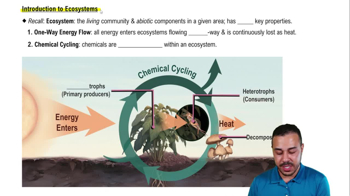
Biodiversity refers to the variety of life in a particular habitat or ecosystem, which is crucial for maintaining ecological balance. Ecosystem services are the benefits that humans derive from ecosystems, such as pollination, pest control, and soil fertility. Preserving natural forests around coffee plantations can enhance these services, supporting both the environment and agricultural productivity.
Recommended video:
 04:07
04:07
Introduction to Ecosystems
Pest Management
Pest management involves strategies to control pest populations that threaten crops. The coffee berry borer beetle is a significant pest for coffee farmers, causing substantial crop losses. Integrating natural habitats can promote the presence of natural predators and reduce reliance on chemical pesticides, leading to more sustainable farming practices.
Recommended video:
 02:30
02:30Introduction to DNA-Based Technology
Agroforestry
Agroforestry is a land-use management system that combines agriculture and forestry to create more sustainable and productive land-use practices. By leaving natural forests in and around coffee plantations, farmers can benefit from shade, improved soil health, and increased biodiversity, which can enhance coffee quality and yield while also conserving natural resources.
Related Practice
Textbook Question
565
views
Textbook Question
Do you drink coffee? A lot of people do—coffee is a major tropical crop, valued at over \$100 billion per year. The most popular species of coffee, Coffea arabica, originated in Africa and is now planted extensively in Central and South America. The pest called the coffee berry borer beetle (Hypothenemus hampeii) moved along with the coffee and is a major problem for coffee farmers, sometimes destroying half of the coffee crop in mature plantations. The abundance of birds and other predators of borer beetles depends on how much natural forest is left within and around the coffee plantations. What is the approximate percentage increase in borer predators per hectare if forest cover is doubled from 15 to 30 percent?
502
views