Back
Back
Problem 9
In Exercises 9–16, a) List all possible rational zeros. b) Use synthetic division to test the possible rational zeros and find an actual zero. c) Use the quotient from part (b) to find the remaining zeros of the polynomial function. f(x)=x3+x2−4x−4
Problem 10
In Exercises 9–16, a) List all possible rational zeros. b) Use synthetic division to test the possible rational zeros and find an actual zero. c) Use the quotient from part (b) to find the remaining zeros of the polynomial function. f(x)=x3−2x2−11x+12
Problem 11
In Exercises 9–16, a) List all possible rational zeros. b) Use synthetic division to test the possible rational zeros and find an actual zero. c) Use the quotient from part (b) to find the remaining zeros of the polynomial function. f(x)=2x3−3x2−11x+6
Problem 13
In Exercises 9–16, a) List all possible rational zeros. b) Use synthetic division to test the possible rational zeros and find an actual zero. c) Use the quotient from part (b) to find the remaining zeros of the polynomial function.
Problem 17
In Exercises 17–24, a) List all possible rational roots. b) List all possible rational roots. c) Use the quotient from part (b) to find the remaining roots and solve the equation. x3−2x2−11x+12=0
Problem 19
In Exercises 17–24, a) List all possible rational roots. b) List all possible rational roots. c) Use the quotient from part (b) to find the remaining roots and solve the equation. x3−10x−12=0
Problem 21
In Exercises 17–24, a) List all possible rational roots. b) List all possible rational roots. c) Use the quotient from part (b) to find the remaining roots and solve the equation. 6x3+25x2−24x+5=0
Problem 23
In Exercises 17–24, a) List all possible rational roots. b) List all possible rational roots. c) Use the quotient from part (b) to find the remaining roots and solve the equation. x4−2x3−5x2+8x+4=0
Problem 25
Find an nth-degree polynomial function with real coefficients satisfying the given conditions. If you are using a graphing utility, use it to graph the function and verify the real zeros and the given function value. n=3; 1 and 5i are zeros; f(-1) = -104
Problem 27
Find an nth-degree polynomial function with real coefficients satisfying the given conditions. If you are using a graphing utility, use it to graph the function and verify the real zeros and the given function value. n=3; -5 and 4+3i are zeros; f(2) = 91
Problem 29
Find an nth-degree polynomial function with real coefficients satisfying the given conditions. If you are using a graphing utility, use it to graph the function and verify the real zeros and the given function value. n=4; i and 3i are zeros; f(-1) = 20
Problem 31
Find an nth-degree polynomial function with real coefficients satisfying the given conditions. If you are using a graphing utility, use it to graph the function and verify the real zeros and the given function value. n=4; -2, 5, and 3+2i are zeros; f(1) = -96
Problem 33
Use Descartes's Rule of Signs to determine the possible number of positive and negative real zeros for each given function. f(x)=x3+2x2+5x+4
Problem 35
Use Descartes's Rule of Signs to determine the possible number of positive and negative real zeros for each given function. f(x)=5x3−3x2+3x−1
Problem 37
Use Descartes's Rule of Signs to determine the possible number of positive and negative real zeros for each given function. f(x)=2x4−5x3−x2−6x+4
Problem 39
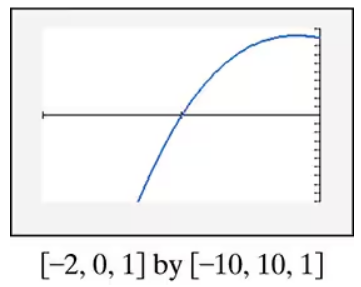
Find all zeros of the polynomial function or solve the given polynomial equation. Use the Rational Zero Theorem, Descartes's Rule of Signs, and possibly the graph of the polynomial function shown by a graphing utility as an aid in obtaining the first zero or the first root. f(x)=x3−4x2−7x+10
Problem 47
Find all zeros of the polynomial function or solve the given polynomial equation. Use the Rational Zero Theorem, Descartes's Rule of Signs, and possibly the graph of the polynomial function shown by a graphing utility as an aid in obtaining the first zero or the first root. f(x)=3x4−11x3−x2+19x+6
Problem 49
Find all zeros of the polynomial function or solve the given polynomial equation. Use the Rational Zero Theorem, Descartes's Rule of Signs, and possibly the graph of the polynomial function shown by a graphing utility as an aid in obtaining the first zero or the first root. 4x4−x3+5x2−2x−6=0
Problem 51
Find all zeros of the polynomial function or solve the given polynomial equation. Use the Rational Zero Theorem, Descartes's Rule of Signs, and possibly the graph of the polynomial function shown by a graphing utility as an aid in obtaining the first zero or the first root. 2x5+7x4−18x2−8x+8=0
Problem 55
Exercises 53–60 show incomplete graphs of given polynomial functions. a) Find all the zeros of each function. b) Without using a graphing utility, draw a complete graph of the function. f(x)=4x3−8x2−3x+9
Problem 59
Exercises 53–60 show incomplete graphs of given polynomial functions. a) Find all the zeros of each function. b) Without using a graphing utility, draw a complete graph of the function. f(x)=3x5+2x4−15x3−10x2+12x+8
Problem 1
Find the domain of each rational function. f(x)=5x/(x−4)
Problem 3
Find the domain of each rational function. g(x)=3x2/(x−5)(x+4)
Problem 5
Find the domain of each rational function. h(x)=(x+7)/(x2−49)
Problem 7
Find the domain of each rational function. f(x)=(x+7)/(x2+49)
Problem 9
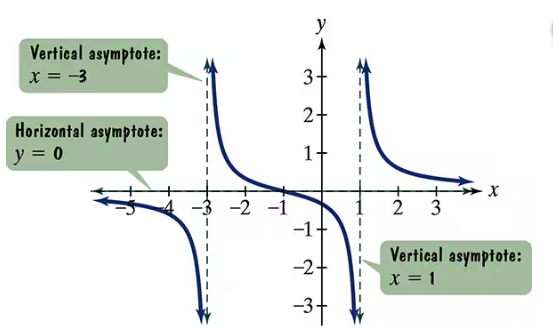
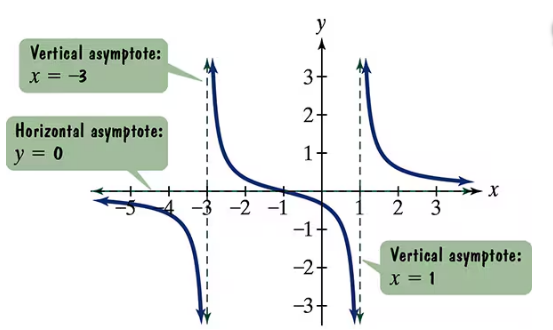
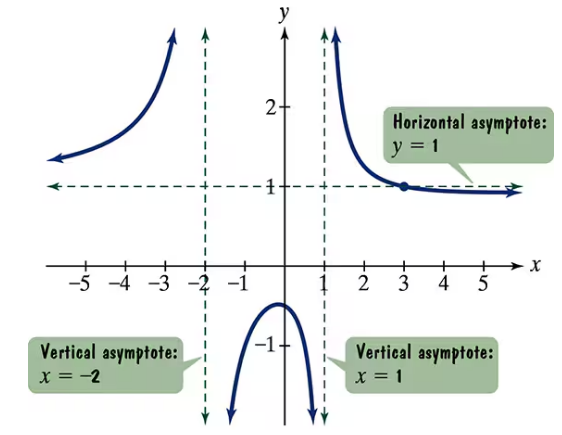
Use the graph of the rational function in the figure shown to complete each statement in Exercises 9–14.
As , ____
Problem 11
Use the graph of the rational function in the figure shown to complete each statement in Exercises 9–14.
As ______
Problem 13
Use the graph of the rational function in the figure shown to complete each statement in Exercises 9–14.
As _____
Problem 15
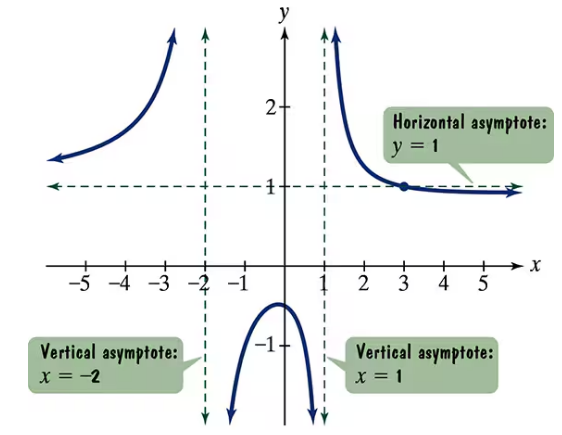
Use the graph of the rational function in the figure shown to complete each statement in Exercises 15–20.
As __
Problem 17
Use the graph of the rational function in the figure shown to complete each statement in Exercises 15–20.
As __