Pearson+ LogoPearson+ Logo
Ch. 6 - Genetic Analysis and Mapping in Bacteria and Bacteriophages
Klug - Concepts of Genetics  12th Edition
Klug12th EditionConcepts of Genetics ISBN: 9780135564776Not the one you use?Change textbook
Chapter 6, Problem 20b

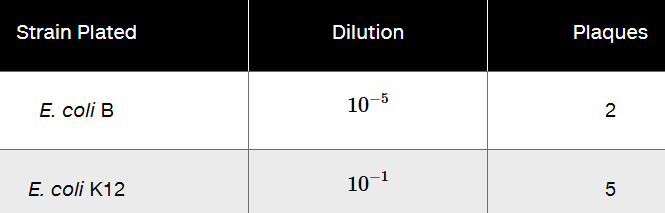
Using mutants 2 and 3 from Problem 19, following mixed infection on E. coli B, progeny viruses were plated in a series of dilutions on both E. coli B and K12 with the following results.
Table showing progeny virus counts: 2 plaques on E. coli B at 10^-5 dilution, 5 plaques on E. coli K12 at 10^-1 dilution.
Another mutation, 6, was tested in relation to mutations 1 through 5 from Problems 18–20. In initial testing, mutant 6 complemented mutants 2 and 3. In recombination testing with 1, 4, and 5, mutant 6 yielded recombinants with 1 and 5, but not with 4. What can you conclude about mutation 6?

Verified step by step guidance
1
Understand the problem: The question involves analyzing complementation and recombination data to determine the relationship of mutation 6 with other mutations. Complementation tests reveal whether two mutations affect the same gene, while recombination tests indicate whether mutations are located on the same or different regions of the genome.
Analyze the complementation data: Mutation 6 complements mutants 2 and 3. This means that mutation 6 is in a different gene than the genes affected by mutations 2 and 3. Complementation occurs when two mutations are in different genes, allowing the functional products of each gene to compensate for the other's defect.
Analyze the recombination data: Mutation 6 yields recombinants with mutations 1 and 5, but not with mutation 4. Recombination occurs when two mutations are on different regions of the same gene or on different genes. The absence of recombinants with mutation 4 suggests that mutation 6 and mutation 4 are very closely linked or in the same location within the same gene.
Combine the complementation and recombination results: Since mutation 6 complements mutations 2 and 3, it is in a different gene than those mutations. The recombination data further suggests that mutation 6 is in the same gene as mutation 4 but in a different region than mutations 1 and 5.
Conclude the relationship of mutation 6: Based on the data, mutation 6 is in the same gene as mutation 4 but in a different gene than mutations 2 and 3. The recombination with mutations 1 and 5 indicates that mutation 6 is in a different region of the genome compared to those mutations.

Verified video answer for a similar problem:

This video solution was recommended by our tutors as helpful for the problem above.
Video duration:
2m
Was this helpful?

Key Concepts

Here are the essential concepts you must grasp in order to answer the question correctly.

Complementation

Complementation occurs when two different mutations in separate genes can restore a common phenotype when present together. In the context of viruses, if mutant 6 complements mutants 2 and 3, it suggests that these mutants have mutations in different genes, allowing the functional gene product from one mutant to compensate for the defective product of the other.
Recommended video:
Guided course
05:05
Complementation

Recombination

Recombination is a genetic process where genetic material is exchanged between different DNA molecules, leading to new allele combinations. In this scenario, mutant 6's ability to yield recombinants with mutants 1 and 5, but not with 4, indicates that mutants 1 and 5 may share genetic pathways with mutant 6, while mutant 4 does not, suggesting a distinct genetic relationship.
Recommended video:
Guided course
03:51
Recombination after Single Strand Breaks

Mutant Analysis

Mutant analysis involves studying variations in organisms to understand gene function and interactions. By analyzing the behavior of mutant 6 in relation to other mutants, researchers can infer the genetic relationships and functional roles of the mutations, providing insights into the underlying genetic architecture of the organism.
Recommended video:
Guided course
02:48
Chi Square Analysis