Pearson+ LogoPearson+ Logo
Ch. 6 - Genetic Analysis and Mapping in Bacteria and Bacteriophages
Klug - Concepts of Genetics  12th Edition
Klug12th EditionConcepts of Genetics ISBN: 9780135564776Not the one you use?Change textbook
Chapter 6, Problem 22

In studies of recombination between mutants 1 and 2 from Problem 21, the results shown in the following table were obtained.Strain Dilution Plaques PhenotypesE. coli B 10⁻⁷ 4 rE. coli K12 10⁻² 8 +Mutant 7 (Problem 21) failed to complement any of the other mutants (1–6). Define the nature of mutant 7.

Verified step by step guidance
1
Identify the key information from the problem: Mutant 7 fails to complement any of the other mutants (1-6).
Understand the concept of complementation: Complementation occurs when two different mutations in the heterozygous state result in a wild-type phenotype. If two mutations do not complement each other, they are likely in the same gene.
Analyze the data provided: The table shows recombination results between mutants 1 and 2, with different plaque phenotypes on E. coli B and K12 strains.
Consider the implications of mutant 7 failing to complement: Since mutant 7 does not complement any of the other mutants, it suggests that mutant 7 has a mutation in the same gene as the other mutants.
Conclude the nature of mutant 7: Mutant 7 likely has a mutation in the same gene as mutants 1-6, indicating it is part of the same complementation group.

Verified video answer for a similar problem:

This video solution was recommended by our tutors as helpful for the problem above.
Video duration:
1m
Was this helpful?

Key Concepts

Here are the essential concepts you must grasp in order to answer the question correctly.

Recombination

Recombination is a genetic process where genetic material is exchanged between different DNA molecules, leading to new combinations of alleles. This process is crucial for understanding genetic diversity and the inheritance of traits. In the context of mutants, recombination can reveal how different mutations interact and whether they can complement each other, which is essential for determining the nature of specific mutants.
Recommended video:
Guided course
03:51
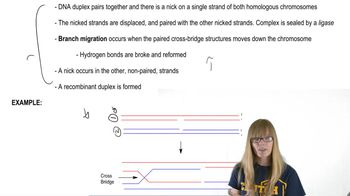
Recombination after Single Strand Breaks

Complementation

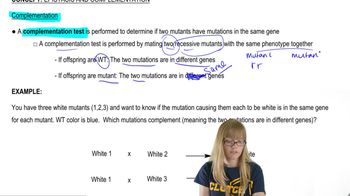
Complementation refers to the phenomenon where two different mutations in a gene can restore the normal function when present together. This is often tested in genetic studies to determine if two mutants affect the same gene or different genes. If mutant 7 fails to complement other mutants, it suggests that it may be a mutation in the same gene as the others, indicating a shared pathway or function.
Recommended video:
Guided course
05:05
Complementation

Phenotypic Analysis

Phenotypic analysis involves studying the observable traits or characteristics of organisms resulting from the interaction of their genotype with the environment. In this case, the phenotypes of the E. coli strains (r and +) provide insights into the effects of the mutations. Understanding these phenotypes is crucial for interpreting the results of the recombination and complementation tests, as they indicate how mutations manifest in the organism.
Recommended video:
Guided course
02:48
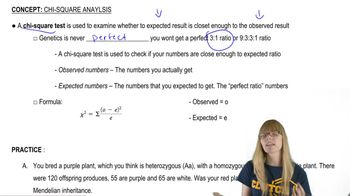
Chi Square Analysis
Related Practice
Textbook Question

Using mutants 2 and 3 from Problem 19, following mixed infection on E. coli B, progeny viruses were plated in a series of dilutions on both E. coli B and K12 with the following results.

What is the recombination frequency between the two mutants?

621
views
Textbook Question

Using mutants 2 and 3 from Problem 19, following mixed infection on E. coli B, progeny viruses were plated in a series of dilutions on both E. coli B and K12 with the following results.

Another mutation, 6, was tested in relation to mutations 1 through 5 from Problems 18–20. In initial testing, mutant 6 complemented mutants 2 and 3. In recombination testing with 1, 4, and 5, mutant 6 yielded recombinants with 1 and 5, but not with 4. What can you conclude about mutation 6?

538
views
Textbook Question

During the analysis of seven rII mutations in phage T4, mutants 1, 2, and 6 were in cistron A, while mutants 3, 4, and 5 were in cistron B. Of these, mutant 4 was a deletion overlapping mutant 5. The remainder were point mutations. Nothing was known about mutant 7. Predict the results of complementation (+ or -) between 1 and 2; 1 and 3; 2 and 4; and 4 and 5.

612
views
Textbook Question

In studies of recombination between mutants 1 and 2 from Problem 21, the results shown in the following table were obtained.

Calculate the recombination frequency.

493
views
Textbook Question

In studies of recombination between mutants 1 and 2 from Problem 21, the results shown in the following table were obtained.

When mutant 6 was tested for recombination with mutant 1, the data were the same as those shown above for strain B, but not for K12. The researcher lost the K12 data but remembered that recombination was ten times more frequent than when mutants 1 and 2 were tested. What were the lost values (dilution and plaque numbers)?

512
views
Textbook Question

In Bacillus subtilis, linkage analysis of two mutant genes affecting the synthesis of two amino acids, tryptophan (trp₂⁻) and tyrosine (trp₁⁻), was performed using transformation. Examine the following data and draw all possible conclusions regarding linkage. What is the purpose of Part B of the experiment? [Reference: E. Nester, M. Schafer, and J. Lederberg (1963).]

718
views