Table of contents
- 1. Introduction to Genetics51m
- 2. Mendel's Laws of Inheritance3h 37m
- 3. Extensions to Mendelian Inheritance2h 41m
- 4. Genetic Mapping and Linkage2h 28m
- 5. Genetics of Bacteria and Viruses1h 21m
- 6. Chromosomal Variation1h 48m
- 7. DNA and Chromosome Structure56m
- 8. DNA Replication1h 10m
- 9. Mitosis and Meiosis1h 34m
- 10. Transcription1h 0m
- 11. Translation58m
- 12. Gene Regulation in Prokaryotes1h 19m
- 13. Gene Regulation in Eukaryotes44m
- 14. Genetic Control of Development44m
- 15. Genomes and Genomics1h 50m
- 16. Transposable Elements47m
- 17. Mutation, Repair, and Recombination1h 6m
- 18. Molecular Genetic Tools19m
- 19. Cancer Genetics29m
- 20. Quantitative Genetics1h 26m
- 21. Population Genetics50m
- 22. Evolutionary Genetics29m
11. Translation
The Genetic Code
Problem 1d
Textbook Question
How were the experimentally derived triplet codon assignments verified in studies using bacteriophage MS2?
Verified step by step guidance1
Understand that the bacteriophage MS2 system was used to experimentally verify the genetic code by synthesizing RNA sequences with known nucleotide compositions and observing the resulting polypeptides.
Recognize that researchers created synthetic RNA molecules with repeating triplet sequences (e.g., repeating codons like UUU, AAA, or CCC) and introduced these RNAs into a cell-free translation system derived from bacteriophage MS2-infected cells.
Observe the polypeptides produced from these synthetic RNAs, identifying the amino acids incorporated by analyzing the protein products, often using techniques like chromatography or electrophoresis.
Correlate the known synthetic RNA triplet sequences with the amino acid sequences of the resulting polypeptides to confirm which triplet codons specify which amino acids.
Use this experimental approach to systematically verify the assignments of triplet codons to amino acids, thereby confirming the genetic code as deciphered from earlier experiments.
Verified video answer for a similar problem:This video solution was recommended by our tutors as helpful for the problem above
Video duration:
1mPlay a video:
Was this helpful?
Key Concepts
Here are the essential concepts you must grasp in order to answer the question correctly.
Triplet Codon Hypothesis
The triplet codon hypothesis states that genetic information is encoded in sequences of three nucleotides, called codons, each specifying a single amino acid. This concept is fundamental to understanding how nucleotide sequences translate into proteins.
Recommended video:
Guided course
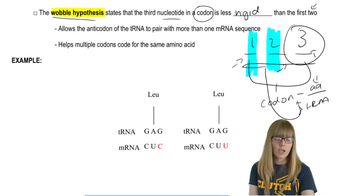
Translation:Wobble Hypothesis
Bacteriophage MS2 as a Model System
Bacteriophage MS2 is an RNA virus used as a model to study genetic coding because its genome is well-characterized and simple. Experiments with MS2 allowed researchers to link specific RNA sequences to amino acid sequences, facilitating verification of codon assignments.
Recommended video:
Guided course
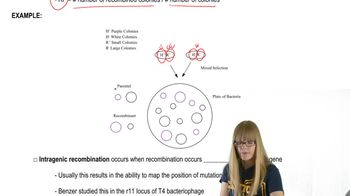
Mapping Bacteriophages
Experimental Verification via Mutagenesis and Protein Analysis
Verification involved inducing mutations in the MS2 RNA and analyzing resulting changes in the viral proteins. By correlating specific nucleotide changes with altered amino acids, researchers confirmed the triplet nature of codons and their assignments.
Recommended video:
Guided course
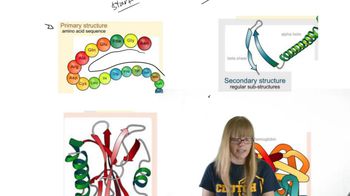
Proteins
Related Videos
Related Practice
Multiple Choice
The nucleic acid sequence in mRNA is determined by which of the following?
47
views