Pearson+ LogoPearson+ Logo
Ch. 18 - Post-transcriptional Regulation in Eukaryotes
Klug - Concepts of Genetics  12th Edition
Klug12th EditionConcepts of Genetics ISBN: 9780135564776Not the one you use?Change textbook
Chapter 18, Problem 12

Present an overview of RNA interference (RNAi). How does the silencing process begin, and what major components participate?

Verified step by step guidance
1
Begin by defining RNA interference (RNAi) as a biological process in which RNA molecules inhibit gene expression or translation by neutralizing targeted mRNA molecules, effectively silencing specific genes.
Explain that the silencing process starts when double-stranded RNA (dsRNA) enters the cell or is produced within the cell, which is recognized as a trigger for RNAi.
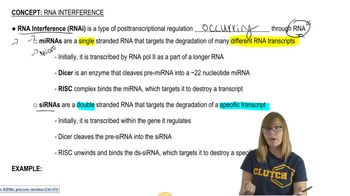
Describe how the enzyme Dicer, a ribonuclease III family member, cleaves the long dsRNA into small interfering RNAs (siRNAs) of about 21-23 nucleotides in length.
Detail that these siRNAs are then incorporated into the RNA-induced silencing complex (RISC), where one strand (the guide strand) is retained and the other (the passenger strand) is degraded.
Clarify that the RISC uses the guide strand to recognize complementary mRNA sequences, leading to the cleavage and degradation of the target mRNA, thereby preventing its translation and silencing the gene.

Verified video answer for a similar problem:

This video solution was recommended by our tutors as helpful for the problem above.
Video duration:
1m
Was this helpful?

Key Concepts

Here are the essential concepts you must grasp in order to answer the question correctly.

RNA Interference (RNAi) Mechanism

RNA interference is a biological process where small RNA molecules inhibit gene expression by neutralizing targeted mRNA molecules. It serves as a regulatory mechanism to control gene activity and defend against viral genomes or transposons.
Recommended video:
Guided course
06:59
RNA Interference

Initiation of RNAi Silencing

The silencing process begins when double-stranded RNA (dsRNA) is recognized and cleaved by the enzyme Dicer into small interfering RNAs (siRNAs). These siRNAs guide the RNA-induced silencing complex (RISC) to complementary mRNA targets for degradation.
Recommended video:
Guided course
07:58
Translation initiation

Major Components of RNAi

Key components include Dicer, which processes dsRNA into siRNAs; Argonaute proteins within the RISC complex, which bind siRNAs and mediate mRNA cleavage; and the siRNAs themselves, which provide sequence specificity for targeting mRNA.
Recommended video:
Guided course
06:25
DNA Structure