Pearson+ LogoPearson+ Logo
Ch.5 Nuclear Chemistry
Timberlake - Chemistry: An Introduction to General, Organic, and Biological Chemistry 13th Edition
Timberlake13th EditionChemistry: An Introduction to General, Organic, and Biological ChemistryISBN: 9780134421353Not the one you use?Change textbook
Chapter 5, Problem 10

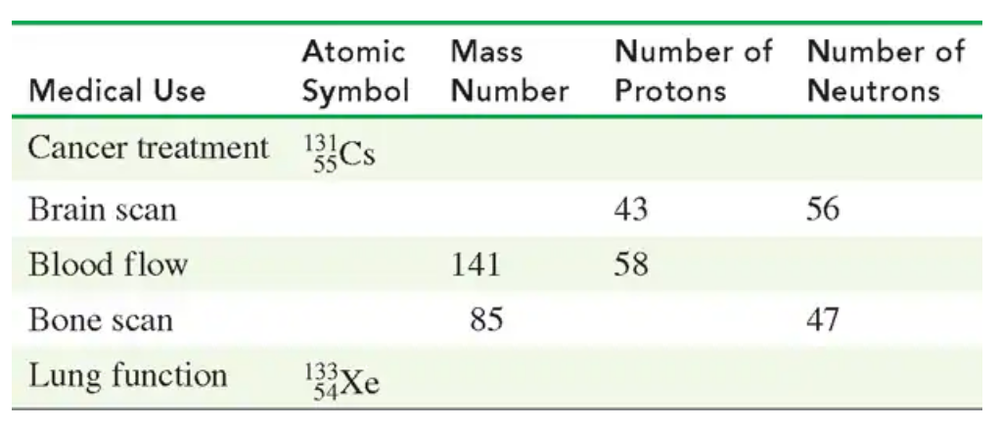
Supply the missing information in the following table:
Table displaying medical uses of isotopes, including atomic symbols, mass numbers, protons, and neutrons.

Verified step by step guidance
1
Step 1: Identify the atomic number from the isotopic symbol. The atomic number is the subscript (lower left number) in the isotopic symbol, which represents the number of protons in the nucleus. For 198^79Au, the atomic number is 79.
Step 2: Determine the mass number from the isotopic symbol. The mass number is the superscript (upper left number) in the isotopic symbol, which represents the total number of protons and neutrons in the nucleus. For 198^79Au, the mass number is 198.
Step 3: Calculate the number of protons. The number of protons is equal to the atomic number. For 198^79Au, the number of protons is 79.
Step 4: Calculate the number of neutrons. The number of neutrons can be found by subtracting the atomic number (number of protons) from the mass number: \( \text{Number of neutrons} = \text{Mass number} - \text{Atomic number} \). For 198^79Au, \( \text{Number of neutrons} = 198 - 79 \).
Step 5: Fill in the missing information in the table based on the calculations: Atomic Number = 79, Mass Number = 198, Number of Protons = 79, Number of Neutrons = (198 - 79).

Verified video answer for a similar problem:

This video solution was recommended by our tutors as helpful for the problem above.
Video duration:
1m
Was this helpful?

Key Concepts

Here are the essential concepts you must grasp in order to answer the question correctly.

Isotopic Symbol

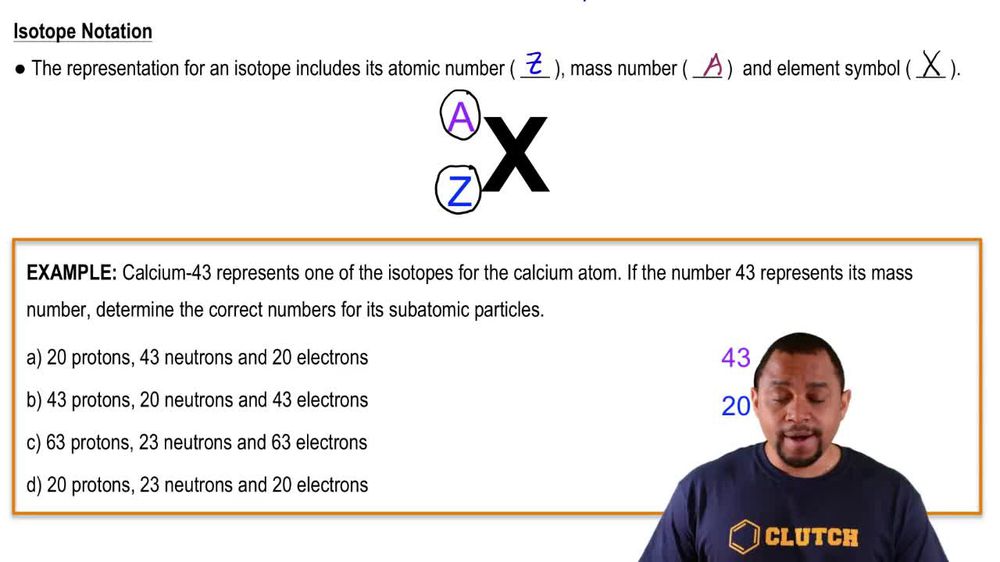
The isotopic symbol represents a specific isotope of an element, denoted by the element's chemical symbol along with its mass number as a superscript and atomic number as a subscript. For example, in the symbol 19879Au, 'Au' stands for gold, '79' is the atomic number indicating the number of protons, and '198' is the mass number, which is the total number of protons and neutrons.
Recommended video:
Guided course
03:57
Isotopes Example 1

Atomic Number

The atomic number is a fundamental property of an element that defines its identity, representing the number of protons in the nucleus of an atom. It determines the element's position in the periodic table and its chemical behavior. For instance, gold (Au) has an atomic number of 79, meaning it has 79 protons and, in a neutral atom, also 79 electrons.
Recommended video:
Guided course
02:42
Calculate Oxidation Numbers

Mass Number and Neutrons

The mass number is the sum of protons and neutrons in an atom's nucleus, providing a measure of the atom's total mass. To find the number of neutrons, subtract the atomic number from the mass number. For example, for the isotope 19879Au, the mass number is 198, and with an atomic number of 79, the number of neutrons is 198 - 79 = 119.
Recommended video:
Guided course
01:21
Mass Percent Example