Pearson+ LogoPearson+ Logo
Ch.18 Metabolic Pathways and ATP Production
Timberlake - Chemistry: An Introduction to General, Organic, and Biological Chemistry 13th Edition
Timberlake13th EditionChemistry: An Introduction to General, Organic, and Biological ChemistryISBN: 9780134421353Not the one you use?Change textbook
Chapter 18, Problem 94f

State if each of the following processes release or require ATP: 
f. first six reactions of glycolysis

Verified step by step guidance
1
Understand the context: Glycolysis is a metabolic pathway that breaks down glucose into pyruvate, producing energy in the form of ATP and NADH. It consists of 10 reactions, divided into two phases: the energy investment phase (first six reactions) and the energy payoff phase.
Recall that the energy investment phase of glycolysis requires ATP. During this phase, ATP is consumed to phosphorylate glucose and its intermediates, making them more reactive and preparing them for subsequent breakdown.
Identify the specific reactions in the first six steps of glycolysis that involve ATP. These include: (1) the phosphorylation of glucose to glucose-6-phosphate (catalyzed by hexokinase) and (2) the phosphorylation of fructose-6-phosphate to fructose-1,6-bisphosphate (catalyzed by phosphofructokinase). Both of these steps require ATP.
Note that the other reactions in the first six steps (e.g., isomerization of glucose-6-phosphate to fructose-6-phosphate, cleavage of fructose-1,6-bisphosphate, and subsequent isomerizations) do not directly involve ATP consumption or production.
Conclude that the first six reactions of glycolysis primarily require ATP, as two molecules of ATP are consumed during the energy investment phase to drive the pathway forward.

Verified video answer for a similar problem:

This video solution was recommended by our tutors as helpful for the problem above.
Video duration:
3m
Was this helpful?

Key Concepts

Here are the essential concepts you must grasp in order to answer the question correctly.

Glycolysis

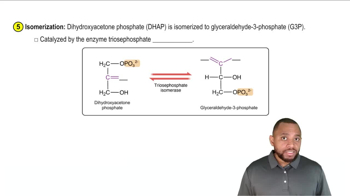
Glycolysis is a metabolic pathway that converts glucose into pyruvate, producing a small amount of ATP in the process. It consists of ten enzyme-catalyzed reactions and is divided into two phases: the energy investment phase, which requires ATP, and the energy payoff phase, which produces ATP. Understanding glycolysis is essential for determining whether specific reactions release or require ATP.
Recommended video:
Guided course
1:26
Glycolysis Concept 5

ATP (Adenosine Triphosphate)

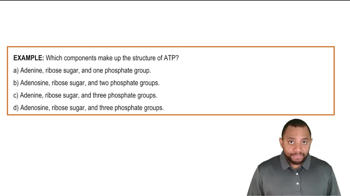
ATP is the primary energy carrier in all living organisms. It stores energy in its high-energy phosphate bonds, which can be released to fuel various cellular processes. In glycolysis, ATP is both consumed in the initial steps and produced in later steps, making it crucial to analyze the net ATP yield of the pathway.
Recommended video:
Guided course
1:03
Adenosine Triphosphate (ATP) Example 2

Energy Investment and Payoff Phases

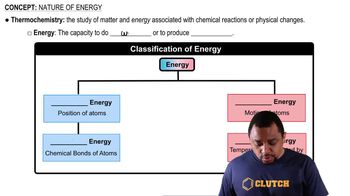
The glycolytic pathway is divided into two main phases: the energy investment phase and the energy payoff phase. The energy investment phase involves the use of ATP to phosphorylate glucose and its intermediates, while the energy payoff phase generates ATP through substrate-level phosphorylation. Recognizing these phases helps clarify which reactions in glycolysis require ATP and which produce it.
Recommended video:
Guided course
01:26
Nature of Energy