Pearson+ LogoPearson+ Logo
Ch.18 Metabolic Pathways and ATP Production
Timberlake - Chemistry: An Introduction to General, Organic, and Biological Chemistry 13th Edition
Timberlake13th EditionChemistry: An Introduction to General, Organic, and Biological ChemistryISBN: 9780134421353Not the one you use?Change textbook
Chapter 18, Problem 93b

One cell at work may break down 2 million (2 000 000) ATP molecules in one second. Some researchers estimate that the human body has about 1013 cells.
b. If ATP has a molar mass of 507 g/mole, how many grams of ATP are hydrolyzed in one day?

Verified step by step guidance
1
Step 1: Calculate the total number of ATP molecules hydrolyzed by all cells in one second. Multiply the number of ATP molecules hydrolyzed by one cell in one second (2,000,000) by the total number of cells in the human body (10¹³).
Step 2: Determine the total number of ATP molecules hydrolyzed in one day. Multiply the result from Step 1 by the number of seconds in a day (24 hours × 60 minutes × 60 seconds = 86,400 seconds).
Step 3: Convert the total number of ATP molecules hydrolyzed in one day to moles. Use Avogadro's number (6.022 × 10²³ molecules/mole) to perform the conversion: divide the total number of ATP molecules by Avogadro's number.
Step 4: Calculate the mass of ATP hydrolyzed in one day. Multiply the number of moles of ATP (from Step 3) by the molar mass of ATP (507 g/mole).
Step 5: Express the final result in grams. This value represents the total mass of ATP hydrolyzed in one day by all the cells in the human body.

Verified video answer for a similar problem:

This video solution was recommended by our tutors as helpful for the problem above.
Video duration:
6m
Was this helpful?

Key Concepts

Here are the essential concepts you must grasp in order to answer the question correctly.

ATP Hydrolysis

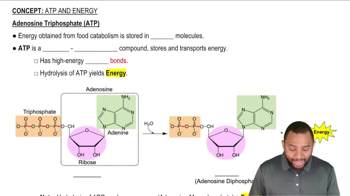
ATP hydrolysis is the process by which adenosine triphosphate (ATP) is broken down into adenosine diphosphate (ADP) and inorganic phosphate, releasing energy. This reaction is crucial for cellular processes, as ATP serves as the primary energy currency in biological systems. Understanding the rate of ATP hydrolysis is essential for calculating energy expenditure in cells.
Recommended video:
Guided course
2:20
Adenosine Triphosphate (ATP) Concept 2

Molar Mass

Molar mass is the mass of one mole of a substance, typically expressed in grams per mole (g/mol). For ATP, the molar mass is given as 507 g/mol, which allows for the conversion between the number of moles and the mass of ATP. This concept is vital for determining how much ATP is consumed based on the number of molecules hydrolyzed.
Recommended video:
Guided course
01:10
Calculating Molar Mass

Cellular Count and Scaling

The cellular count refers to the total number of cells in the human body, estimated to be around 10¹³ cells. This number is significant when scaling up the ATP hydrolysis rate from a single cell to the entire body. By multiplying the ATP breakdown rate per cell by the total number of cells, one can calculate the total ATP hydrolyzed in a given time frame, such as one day.
Recommended video: