Pearson+ LogoPearson+ Logo
Ch.9 Solutions
Timberlake - Chemistry: An Introduction to General, Organic, and Biological Chemistry 13th Edition
Timberlake13th EditionChemistry: An Introduction to General, Organic, and Biological ChemistryISBN: 9780134421353Not the one you use?Change textbook
Chapter 9, Problem 113b

In a laboratory experiment, a 10.0-mL sample of NaCl solution is poured into an evaporating dish with a mass of 24.10 g. The combined mass of the evaporating dish and NaCl solution is 36.15 g. After heating, the evaporating dish and dry NaCl have a combined mass of 25.50 g.
b. What is the molarity (M) of the NaCl solution?

Verified step by step guidance
1
Determine the mass of the NaCl solution by subtracting the mass of the empty evaporating dish from the combined mass of the evaporating dish and NaCl solution: \( \text{Mass of NaCl solution} = \text{Mass of dish + solution} - \text{Mass of dish} \).
Calculate the mass of the dry NaCl by subtracting the mass of the empty evaporating dish from the combined mass of the evaporating dish and dry NaCl: \( \text{Mass of dry NaCl} = \text{Mass of dish + dry NaCl} - \text{Mass of dish} \).
Determine the mass of water in the NaCl solution by subtracting the mass of the dry NaCl from the mass of the NaCl solution: \( \text{Mass of water} = \text{Mass of NaCl solution} - \text{Mass of dry NaCl} \).
Convert the mass of dry NaCl to moles using the molar mass of NaCl (\( 58.44 \ \text{g/mol} \)): \( \text{Moles of NaCl} = \frac{\text{Mass of dry NaCl}}{\text{Molar mass of NaCl}} \).
Calculate the molarity (M) of the NaCl solution by dividing the moles of NaCl by the volume of the solution in liters: \( \text{Molarity} = \frac{\text{Moles of NaCl}}{\text{Volume of solution in liters}} \). Remember to convert the volume from milliliters to liters by dividing by 1000.

Verified video answer for a similar problem:

This video solution was recommended by our tutors as helpful for the problem above.
Video duration:
5m
Was this helpful?

Key Concepts

Here are the essential concepts you must grasp in order to answer the question correctly.

Molarity

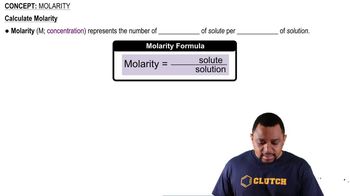
Molarity (M) is a measure of concentration defined as the number of moles of solute per liter of solution. It is calculated using the formula M = moles of solute / liters of solution. Understanding molarity is essential for determining how concentrated a solution is, which is crucial in laboratory experiments and chemical reactions.
Recommended video:

Mass and Moles Relationship

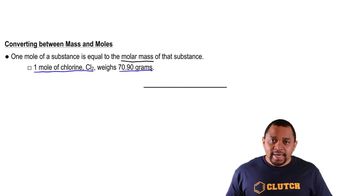
The relationship between mass and moles is governed by the formula: moles = mass (g) / molar mass (g/mol). This concept is vital for converting the mass of a solute into moles, allowing for the calculation of molarity. Knowing the molar mass of NaCl (58.44 g/mol) is necessary to perform these conversions accurately.
Recommended video:

Evaporation and Residue

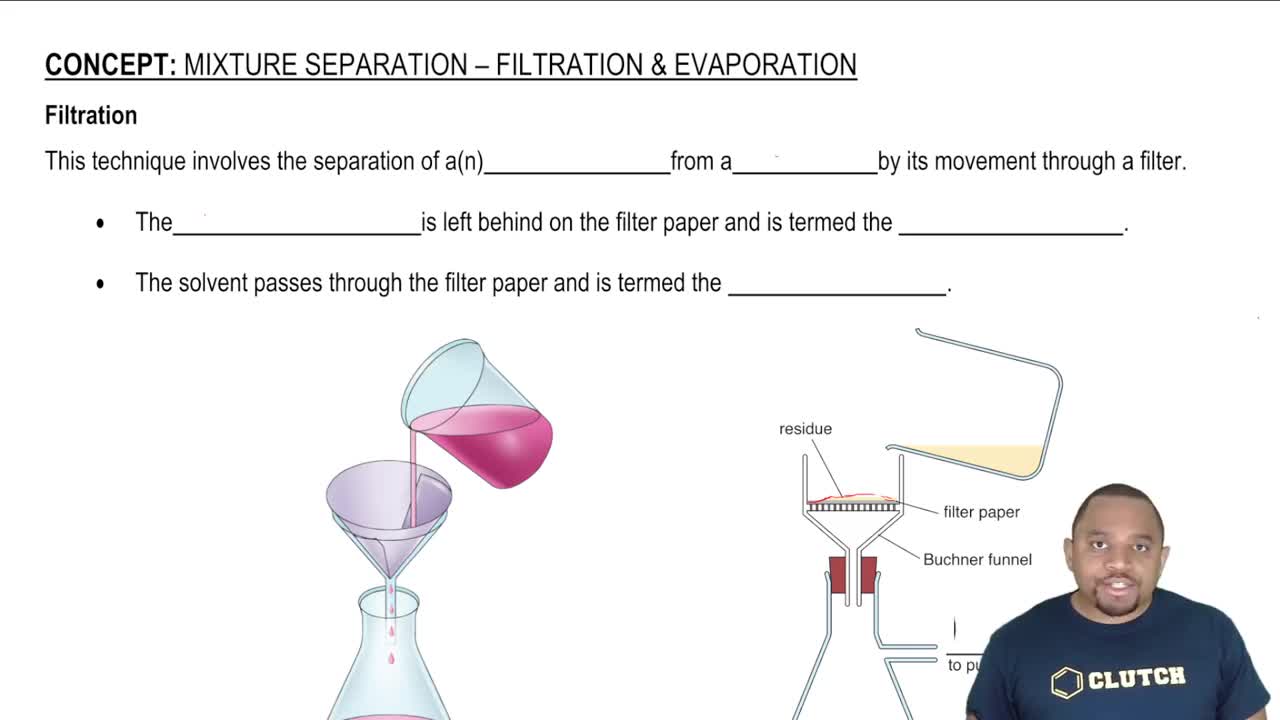
Evaporation is the process of turning a liquid into vapor, which can be used to separate a solute from a solvent. In this experiment, heating the NaCl solution causes the water to evaporate, leaving behind dry NaCl. Understanding this process helps in determining the amount of solute present after evaporation, which is crucial for calculating the molarity of the original solution.
Recommended video:
Guided course
03:56
Filtration and Evaporation
Related Practice
Textbook Question

Potassium nitrate has a solubility of 32 g of KNO3 in 100. g of H2O at 20 °C. Determine if each of the following forms an unsaturated or saturated solution at 20 °C:

a. adding 32 g of KNO3 to 200. g of H2O

2012
views
Textbook Question

An 80-proof brandy is a 40.% (v/v) ethanol solution. The "proof" is twice the percent concentration of alcohol in the beverage. How many milliliters of alcohol are present in 750 mL of brandy?

1320
views
Textbook Question

In a laboratory experiment, a 10.0-mL sample of NaCl solution is poured into an evaporating dish with a mass of 24.10 g. The combined mass of the evaporating dish and NaCl solution is 36.15 g. After heating, the evaporating dish and dry NaCl have a combined mass of 25.50 g.

a. What is the mass percent (m/m) of the NaCl solution?

3015
views
2
rank
Textbook Question

In a laboratory experiment, a 10.0-mL sample of NaCl solution is poured into an evaporating dish with a mass of 24.10 g. The combined mass of the evaporating dish and NaCl solution is 36.15 g. After heating, the evaporating dish and dry NaCl have a combined mass of 25.50 g.

c. If water is added to 10.0 mL of the initial NaCl solution to give a final volume of 60.0 mL, what is the molarity of the diluted NaCl solution?

1872
views
Textbook Question

A solution is prepared with 70.0 g of HNO3 and 130.0 g of H2O. The HNO3 solution has a density of 1.21 g/mL.

b. What is the total volume, in milliliters, of the solution?

1569
views
Textbook Question

A solution is prepared with 70.0 g of HNO3 and 130.0 g of H2O. The HNO3 solution has a density of 1.21 g/mL. (9.4)

d. What is the molarity (M) of the solution?

2267
views