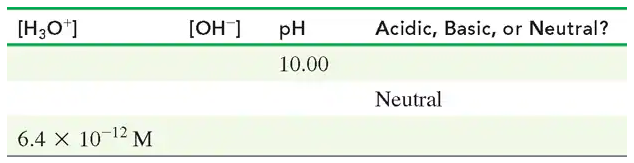
Step 1: Recall the relationship between hydronium ion concentration ([H₃O⁺]) and hydroxide ion concentration ([OH⁻]) in water. The product of these concentrations is given by the ionization constant of water: \( [H₃O⁺] \times [OH⁻] = 1.0 \times 10^{-14} \) at 25°C.
Step 2: Use the given [H₃O⁺] value (\( 1.0 \times 10^{-12} \)) to calculate [OH⁻]. Rearrange the equation to solve for [OH⁻]: \( [OH⁻] = \frac{1.0 \times 10^{-14}}{[H₃O⁺]} \). Substitute \( [H₃O⁺] = 1.0 \times 10^{-12} \) into the equation.
Step 3: Calculate the pH using the formula \( \text{pH} = -\log([H₃O⁺]) \). Substitute \( [H₃O⁺] = 1.0 \times 10^{-12} \) into the formula to determine the pH value.
Step 4: Determine whether the substance is acidic, neutral, or basic based on the pH value. Recall that a pH less than 7 indicates an acidic solution, a pH of 7 indicates a neutral solution, and a pH greater than 7 indicates a basic solution.
Step 5: Summarize the table by filling in the calculated [OH⁻], pH, and the classification (acidic, neutral, or basic) based on the pH value.
Verified video answer for a similar problem:
This video solution was recommended by our tutors as helpful for the problem above
Video duration:
1m
Play a video:
Was this helpful?
Key Concepts
Here are the essential concepts you must grasp in order to answer the question correctly.
Hydronium Ion Concentration
Hydronium ion concentration, represented as [H3O+], indicates the amount of hydronium ions present in a solution. It is a crucial factor in determining the acidity of a solution; higher concentrations correspond to more acidic solutions. In the case of bleach, the concentration is given as 1.0×10^-12 M, which suggests a low level of acidity.
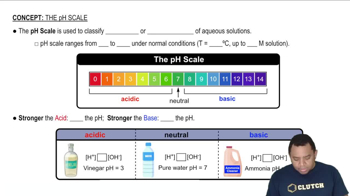
The pH scale quantifies the acidity or basicity of a solution, ranging from 0 to 14. A pH of 7 is considered neutral, while values below 7 indicate acidity and values above 7 indicate basicity. The pH can be calculated from the hydronium ion concentration using the formula pH = -log[H3O+]. For bleach, the low hydronium concentration will result in a high pH, indicating a basic solution.
This classification describes the nature of a solution based on its pH level. Solutions with a pH less than 7 are acidic, those with a pH of 7 are neutral, and those with a pH greater than 7 are basic. Understanding this classification is essential for interpreting the properties of substances like bleach, which is typically basic due to its low hydronium ion concentration.