How is ATP used in the initial steps of glycolysis?
Verified step by step guidance
1
Understand that glycolysis is the metabolic pathway that breaks down glucose into pyruvate, producing energy in the form of ATP and NADH. The initial steps of glycolysis are energy-investment steps where ATP is consumed to prepare glucose for further breakdown.
In the first step of glycolysis, ATP is used to phosphorylate glucose. This reaction is catalyzed by the enzyme hexokinase, and the product is glucose-6-phosphate. The reaction can be represented as: .
In the third step of glycolysis, another ATP molecule is used. The enzyme phosphofructokinase catalyzes the phosphorylation of fructose-6-phosphate to form fructose-1,6-bisphosphate. This reaction can be represented as: .
Recognize that the phosphorylation of glucose and fructose-6-phosphate by ATP makes these molecules more reactive and traps them inside the cell, as phosphorylated sugars cannot easily cross the cell membrane.
Summarize that ATP is used in the initial steps of glycolysis to invest energy, enabling the glucose molecule to be primed for subsequent breakdown and energy extraction in later steps of the pathway.
Verified video answer for a similar problem:
This video solution was recommended by our tutors as helpful for the problem above
Video duration:
1m
Play a video:
Was this helpful?
Key Concepts
Here are the essential concepts you must grasp in order to answer the question correctly.
Adenosine Triphosphate (ATP)
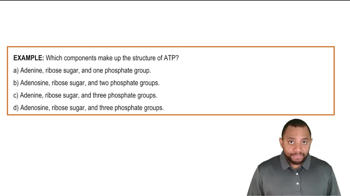
ATP is the primary energy carrier in all living organisms. It consists of adenine, ribose, and three phosphate groups. The energy stored in the high-energy bonds between the phosphate groups is released when ATP is hydrolyzed to ADP and inorganic phosphate, making it essential for various cellular processes, including glycolysis.
Glycolysis is a metabolic pathway that converts glucose into pyruvate, producing a small amount of ATP and NADH in the process. It occurs in the cytoplasm and consists of ten enzymatic reactions, divided into two phases: the energy investment phase and the energy payoff phase. The initial steps of glycolysis require ATP to phosphorylate glucose and its derivatives, facilitating subsequent reactions.
Phosphorylation is the addition of a phosphate group to a molecule, which often alters the molecule's activity or function. In glycolysis, the phosphorylation of glucose to glucose-6-phosphate is a crucial step that traps glucose in the cell and prepares it for further breakdown. This process is catalyzed by the enzyme hexokinase and is vital for the regulation of glucose metabolism.