Pearson+ LogoPearson+ Logo
Ch.9 Solutions
Timberlake - Chemistry: An Introduction to General, Organic, and Biological Chemistry 13th Edition
Timberlake13th EditionChemistry: An Introduction to General, Organic, and Biological ChemistryISBN: 9780134421353Not the one you use?Change textbook
Chapter 9, Problem 9d

Write a balanced equation for the dissociation of each of the following strong electrolytes in water:
d. Fe(NO3)3

Verified step by step guidance
1
Identify the strong electrolyte: Fe(NO₃)₃ is iron(III) nitrate, a strong electrolyte that dissociates completely in water into its constituent ions.
Determine the ions produced: Iron(III) nitrate dissociates into Fe³⁺ (iron(III) ion) and NO₃⁻ (nitrate ion).
Write the unbalanced dissociation equation: Fe(NO₃)₃ → Fe³⁺ + NO₃⁻.
Balance the equation: Since there are three nitrate ions (NO₃⁻) in one formula unit of Fe(NO₃)₃, the balanced equation is Fe(NO₃)₃ → Fe³⁺ + 3NO₃⁻.
Verify the charge balance: The total positive charge from Fe³⁺ (3+) is balanced by the total negative charge from 3NO₃⁻ (3 × 1−), ensuring the equation is correctly balanced.

Verified video answer for a similar problem:

This video solution was recommended by our tutors as helpful for the problem above.
Video duration:
3m
Was this helpful?

Key Concepts

Here are the essential concepts you must grasp in order to answer the question correctly.

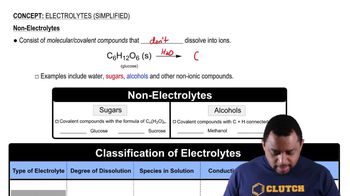
Dissociation of Electrolytes

Dissociation refers to the process by which an ionic compound separates into its constituent ions when dissolved in water. Strong electrolytes, such as salts, completely dissociate in solution, meaning that all of the solute breaks apart into ions. This is crucial for understanding how compounds like Fe(NO₃)₃ behave in aqueous solutions.
Recommended video:
Guided course
02:11
Electrolytes (Simplified) Concept 3

Ionic Compounds

Ionic compounds are formed from the electrostatic attraction between positively charged cations and negatively charged anions. In the case of Fe(NO₃)₃, iron (Fe) acts as the cation, while the nitrate ion (NO₃) serves as the anion. Recognizing the structure of ionic compounds is essential for predicting their behavior in solution, including their dissociation.
Recommended video:
Guided course
02:11
Naming Ionic Compounds

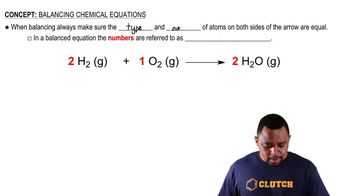
Balanced Chemical Equations

A balanced chemical equation represents a chemical reaction with equal numbers of each type of atom on both sides of the equation. For the dissociation of Fe(NO₃)₃, it is important to write the equation correctly to reflect the stoichiometry of the ions produced. This ensures that the law of conservation of mass is upheld in the reaction.
Recommended video:
Guided course
01:32
Balancing Chemical Equations (Simplified) Concept 1