Pearson+ LogoPearson+ Logo
Ch.6 Ionic and Molecular Compounds
Timberlake - Chemistry: An Introduction to General, Organic, and Biological Chemistry 13th Edition
Timberlake13th EditionChemistry: An Introduction to General, Organic, and Biological ChemistryISBN: 9780134421353Not the one you use?Change textbook
Chapter 6, Problem 93c

Why are Group 1A (1) and Group 2A (2) elements found in many compounds, but not Group 8A (18) elements?

Verified step by step guidance
1
Group 1A (1) and Group 2A (2) elements are highly reactive because they have one or two valence electrons, respectively, which they readily lose to achieve a stable electron configuration (a full outer shell, often resembling the electron configuration of a noble gas).
Group 8A (18) elements, also known as noble gases, already have a full outer electron shell, making them very stable and unreactive under normal conditions. This stability is due to their electron configuration, which satisfies the octet rule (except for helium, which has a full shell with two electrons).
The reactivity of Group 1A and Group 2A elements leads them to form ionic or covalent bonds with other elements to achieve stability. For example, sodium (Na) from Group 1A readily reacts with chlorine (Cl) to form sodium chloride (NaCl).
In contrast, Group 8A elements do not need to gain, lose, or share electrons to achieve stability, so they rarely form compounds. When they do, it is typically under extreme conditions or with highly reactive species.
Thus, the difference in reactivity between these groups explains why Group 1A and Group 2A elements are commonly found in compounds, while Group 8A elements are not.

Verified video answer for a similar problem:

This video solution was recommended by our tutors as helpful for the problem above.
Video duration:
4m
Was this helpful?

Key Concepts

Here are the essential concepts you must grasp in order to answer the question correctly.

Chemical Reactivity

Chemical reactivity refers to the tendency of a substance to undergo chemical changes, forming new compounds. Group 1A (alkali metals) and Group 2A (alkaline earth metals) elements are highly reactive due to their desire to lose electrons and achieve a stable electron configuration. In contrast, Group 8A (noble gases) elements have a complete valence shell, making them largely inert and unreactive, which explains their scarcity in compounds.
Recommended video:
Guided course
02:11
Chemical Properties Example 1

Electron Configuration

Electron configuration describes the distribution of electrons in an atom's orbitals. Group 1A and 2A elements have one and two electrons in their outermost shell, respectively, which they readily lose to form positive ions. This loss of electrons leads to the formation of ionic bonds with nonmetals, resulting in a variety of compounds, while Group 8A elements possess a full outer shell, making them stable and unlikely to form bonds.
Recommended video:
Guided course
01:08
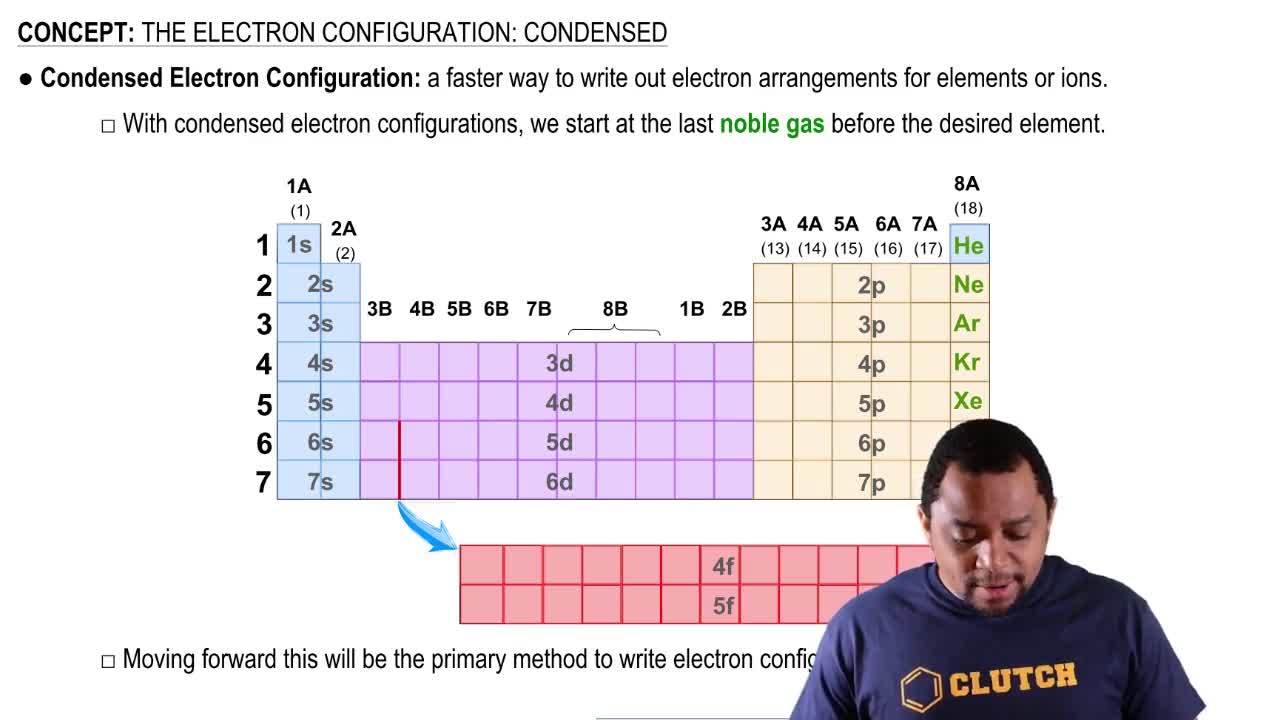
The Electron Configuration: Condensed

Ionic and Covalent Bonding

Ionic and covalent bonding are two primary types of chemical bonds. Group 1A and 2A elements typically form ionic bonds by transferring electrons to nonmetals, resulting in the formation of stable ionic compounds. In contrast, Group 8A elements do not participate in bonding due to their stable electron configuration, which limits their ability to form compounds, thus explaining their absence in many chemical reactions.
Recommended video:
Guided course
01:13
Covalent Bonds Example 2