Pearson+ LogoPearson+ Logo
Ch.9 Solutions
Timberlake - Chemistry: An Introduction to General, Organic, and Biological Chemistry 13th Edition
Timberlake13th EditionChemistry: An Introduction to General, Organic, and Biological ChemistryISBN: 9780134421353Not the one you use?Change textbook
Chapter 9, Problem 16d

Calculate the number of equivalents in each of the following:
d. 2 moles of Fe3+

Verified step by step guidance
1
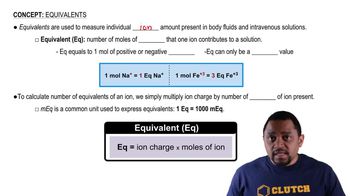
Understand the concept of equivalents: In chemistry, an equivalent is the amount of a substance that reacts with or supplies 1 mole of hydrogen ions (H⁺) or electrons in a reaction. For ions, the number of equivalents is determined by multiplying the number of moles by the charge of the ion.
Identify the charge of the ion: The problem specifies Fe³⁺, which has a charge of +3.
Write the formula to calculate the number of equivalents: The number of equivalents is given by the equation: neq=nmoles×charge.
Substitute the given values into the formula: Here, the number of moles is 2, and the charge of Fe³⁺ is 3. So, the calculation becomes: neq=2×3.
Perform the multiplication to determine the number of equivalents. This will give you the final result.

Verified video answer for a similar problem:

This video solution was recommended by our tutors as helpful for the problem above.
Video duration:
1m
Was this helpful?

Key Concepts

Here are the essential concepts you must grasp in order to answer the question correctly.

Equivalents

In chemistry, an equivalent is a measure of reactive capacity. It is defined as the amount of a substance that can react with or replace one mole of hydrogen ions (H⁺) in a reaction. The concept of equivalents is crucial for stoichiometry, as it allows chemists to relate the amounts of reactants and products in a chemical reaction based on their reactivity.
Recommended video:
Guided course
01:43
Equivalents Concept 1

Moles

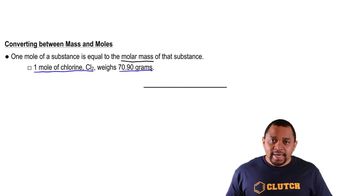
A mole is a fundamental unit in chemistry that quantifies the amount of substance. One mole contains approximately 6.022 x 10²³ entities, such as atoms or molecules. Understanding moles is essential for converting between mass and number of particles, which is vital for calculating equivalents in reactions involving ions like Fe³⁺.
Recommended video:

Valency

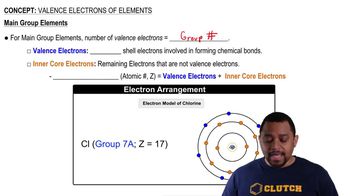
Valency refers to the combining capacity of an element, often indicated by the number of electrons an atom can lose, gain, or share during a chemical reaction. For Fe³⁺, the valency is +3, meaning it can combine with three equivalents of other ions or molecules. This concept is important for determining the number of equivalents when calculating the reactivity of ions in solutions.
Recommended video:
Guided course
01:55
Valence Electrons of Elements (Simplified) Concept 1