Pearson+ LogoPearson+ Logo
Ch.6 Ionic and Molecular Compounds
Timberlake - Chemistry: An Introduction to General, Organic, and Biological Chemistry 13th Edition
Timberlake13th EditionChemistry: An Introduction to General, Organic, and Biological ChemistryISBN: 9780134421353Not the one you use?Change textbook
Chapter 6, Problem 112b

Consider an ion with the symbol Y3- formed from a representative element.
b. What is the Lewis symbol of the element?

Verified step by step guidance
1
Step 1: Understand the problem. The ion Y³⁻ indicates that the element Y has gained 3 electrons to form a negatively charged ion. This means the neutral atom of Y originally had 3 fewer electrons than the ion.
Step 2: Determine the group of the periodic table. Since Y³⁻ is a representative element, it is likely in Group 15 (5A) of the periodic table. Elements in this group typically gain 3 electrons to achieve a stable octet configuration.
Step 3: Identify the neutral atom's electron configuration. The neutral atom of Y would have 5 valence electrons (as it is in Group 15). These electrons are represented as dots in the Lewis symbol.
Step 4: Draw the Lewis symbol for the neutral atom. Place the element symbol 'Y' in the center and arrange 5 dots around it to represent the 5 valence electrons. The dots should be placed one at a time on each side (top, bottom, left, right) before pairing them.
Step 5: Verify the Lewis symbol. Ensure that the Lewis symbol accurately represents the 5 valence electrons of the neutral atom of Y, consistent with its position in Group 15 of the periodic table.

Verified video answer for a similar problem:

This video solution was recommended by our tutors as helpful for the problem above.
Video duration:
2m
Was this helpful?

Key Concepts

Here are the essential concepts you must grasp in order to answer the question correctly.

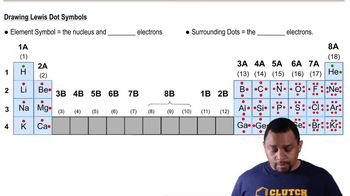
Lewis Symbols

Lewis symbols are a way to represent the valence electrons of an atom using dots around the element's symbol. Each dot corresponds to a valence electron, and the arrangement of these dots can help predict how an element will bond with others. For representative elements, the number of dots typically corresponds to the group number in the periodic table.
Recommended video:
Guided course
01:27
Lewis Dot Symbols (Simplified) Concept 2

Ion Formation

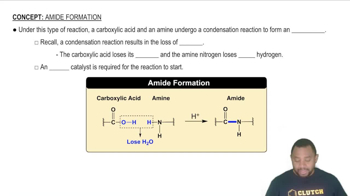
Ions are charged particles that form when atoms gain or lose electrons. A negatively charged ion, or anion, occurs when an atom gains electrons, resulting in a net negative charge. The symbol Y³⁻ indicates that the element Y has gained three electrons, which is crucial for understanding its Lewis symbol and bonding behavior.
Recommended video:
Guided course
1:41
Amide Formation Concept 1

Representative Elements

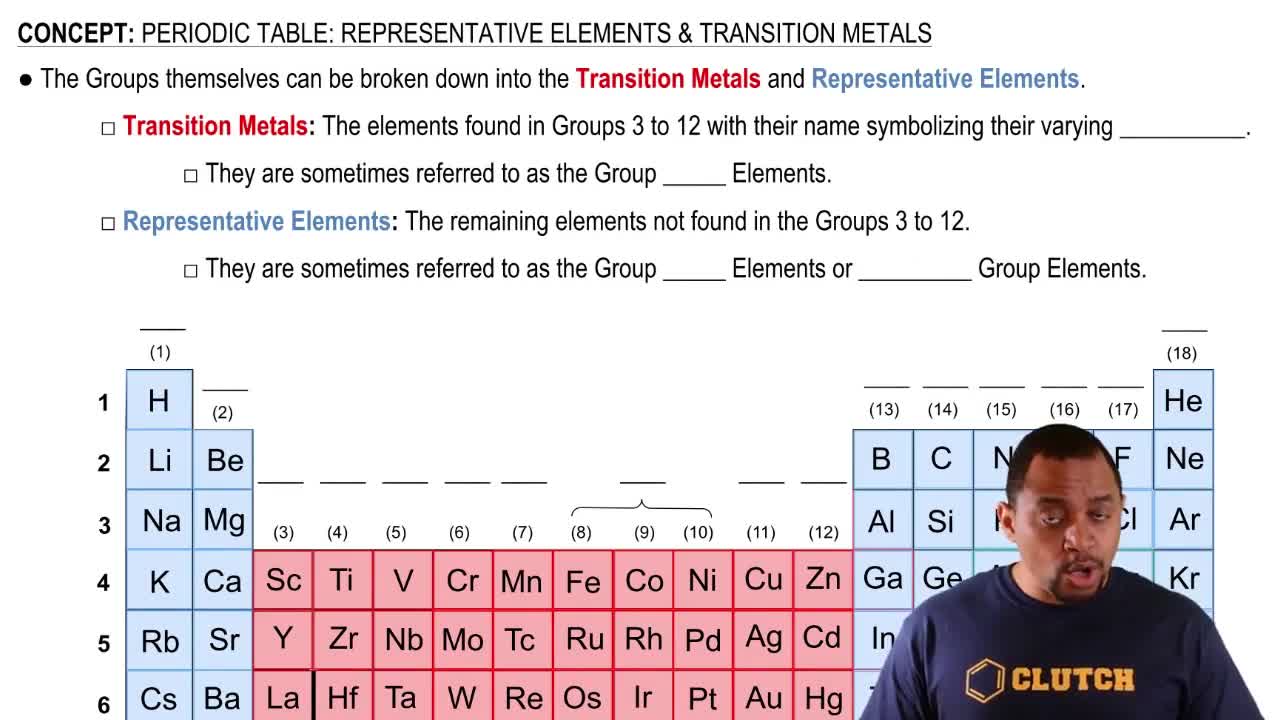
Representative elements are found in groups 1, 2, and 13-18 of the periodic table and include metals, nonmetals, and metalloids. These elements exhibit a wide range of chemical properties and typically follow predictable patterns in their electron configurations. Understanding the group of the representative element helps in determining its Lewis symbol and the number of valence electrons.
Recommended video:
Guided course
03:30
Periodic Table: Representative Elements & Transition Metals