
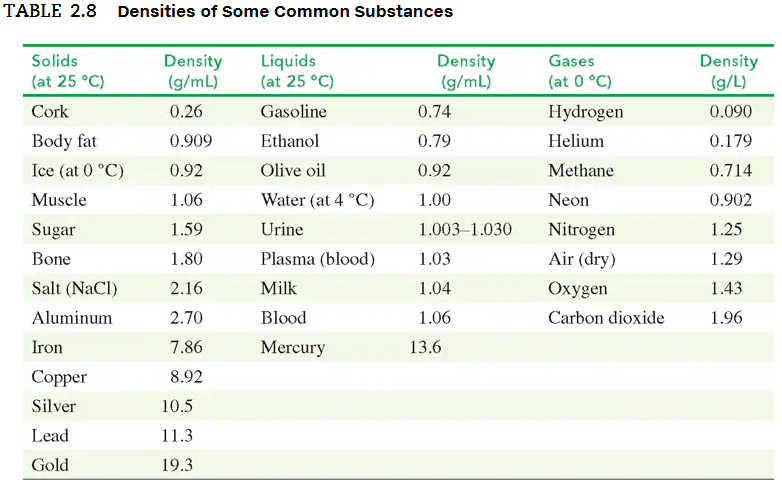
In an old trunk, you find a piece of metal that you think may be aluminum, silver, or lead. You take it to a lab, where you find it has a mass of 217 g and a volume of 19.2 cm3. Using TABLE 2.8, what is the metal you found?
Verified step by step guidance
1
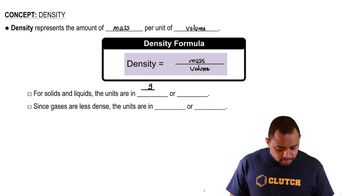
Step 1: Recall the formula for density, which is given by \( \text{Density} = \frac{\text{Mass}}{\text{Volume}} \). This formula will help us calculate the density of the metal using the given mass and volume.
Step 2: Substitute the given values into the formula. The mass is 217 g, and the volume is 19.2 cm³. The equation becomes \( \text{Density} = \frac{217}{19.2} \).
Step 3: Perform the division to calculate the density of the metal. This will give you the density in units of g/cm³.
Step 4: Compare the calculated density to the densities of aluminum, silver, and lead provided in TABLE 2.8. Each metal has a characteristic density, so the closest match will identify the metal.
Step 5: Based on the comparison, determine which metal (aluminum, silver, or lead) has a density that matches the calculated value. This will allow you to identify the metal found in the trunk.
Verified video answer for a similar problem:
This video solution was recommended by our tutors as helpful for the problem above
Video duration:
2m
Play a video:
Was this helpful?
Key Concepts
Here are the essential concepts you must grasp in order to answer the question correctly.
Density
Density is defined as the mass of an object divided by its volume, typically expressed in grams per cubic centimeter (g/cm³). It is a fundamental property that helps identify materials, as different substances have unique densities. In this case, calculating the density of the metal found will allow for comparison with known densities of aluminum, silver, and lead.
Material properties refer to the characteristics that define how a material behaves under various conditions. For metals, properties such as density, melting point, and conductivity are crucial for identification. Understanding these properties helps in distinguishing between metals like aluminum, silver, and lead, each of which has distinct physical and chemical attributes.
Reference tables, such as TABLE 2.8 mentioned in the question, provide standardized data for various materials, including their densities. These tables are essential tools in scientific analysis, allowing for quick comparisons and identifications based on measured values. By consulting such a table, one can determine which metal corresponds to the calculated density of the found object.