
Pearson+ LogoPearson+ Logo
Ch.2 Chemistry and Measurements
Timberlake - Chemistry: An Introduction to General, Organic, and Biological Chemistry 13th Edition
Timberlake13th EditionChemistry: An Introduction to General, Organic, and Biological ChemistryISBN: 9780134421353Not the one you use?Change textbook
Chapter 2, Problem 77a

Solve each of the following problems:
a. A urine sample has a density of 1.030 g/mL. What is the specific gravity of the sample?

Verified step by step guidance
1
Understand the concept of specific gravity: Specific gravity is a dimensionless quantity that compares the density of a substance to the density of water at a specific temperature (usually 4°C, where the density of water is approximately 1.000 g/mL). The formula for specific gravity is: SpecificGravity=Density(sample)Density(water).
Identify the given values: The density of the urine sample is provided as 1.030 g/mL, and the density of water is approximately 1.000 g/mL at 4°C.
Substitute the values into the formula: Replace the density of the sample and the density of water in the formula for specific gravity. This gives: SpecificGravity=1.030 g/mL1.000 g/mL.
Perform the division: Divide the density of the urine sample (1.030 g/mL) by the density of water (1.000 g/mL). Since the units cancel out, the result will be a dimensionless number.
Interpret the result: The specific gravity of the urine sample is a comparison to water, and the value obtained indicates how much denser the urine sample is relative to water. Specific gravity values greater than 1 indicate the sample is denser than water.

Verified video answer for a similar problem:

This video solution was recommended by our tutors as helpful for the problem above.
Video duration:
1m
Was this helpful?

Key Concepts

Here are the essential concepts you must grasp in order to answer the question correctly.

Density

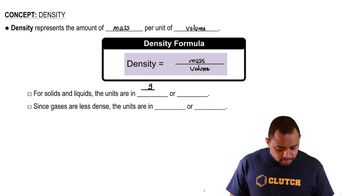
Density is defined as the mass of a substance per unit volume, typically expressed in grams per milliliter (g/mL) or kilograms per cubic meter (kg/m³). It is a fundamental property that helps in identifying substances and understanding their behavior in different environments. In this context, the density of the urine sample is given as 1.030 g/mL, which is crucial for calculating its specific gravity.
Recommended video:

Specific Gravity

Specific gravity is a dimensionless quantity that compares the density of a substance to the density of a reference substance, usually water at 4°C, which has a density of 1.000 g/mL. It is calculated by dividing the density of the substance by the density of water. Specific gravity provides insight into the concentration of solutes in a solution, making it particularly useful in medical diagnostics, such as evaluating urine samples.
Recommended video:
Guided course
01:37
Specific Gravity

Calculation of Specific Gravity

To calculate specific gravity, the formula used is: Specific Gravity = Density of the substance / Density of water. For the urine sample with a density of 1.030 g/mL, the specific gravity can be determined by dividing this value by the density of water (1.000 g/mL). This calculation allows for a straightforward comparison of the urine's density relative to water, indicating its concentration and potential health implications.
Recommended video:
Guided course
01:37
Specific Gravity