
Pearson+ LogoPearson+ Logo
Ch.2 Chemistry and Measurements
Timberlake - Chemistry: An Introduction to General, Organic, and Biological Chemistry 13th Edition
Timberlake13th EditionChemistry: An Introduction to General, Organic, and Biological ChemistryISBN: 9780134421353Not the one you use?Change textbook
Chapter 2, Problem 77c

Solve each of the following problems:
c. The specific gravity of a vegetable oil is 0.92. What is the mass, in grams, of 750 mL of vegetable oil?

Verified step by step guidance
1
Understand the concept of specific gravity: Specific gravity is the ratio of the density of a substance to the density of water. Since the density of water is approximately 1 g/mL, the specific gravity of 0.92 indicates that the density of the vegetable oil is 0.92 g/mL.
Recall the formula for mass: Mass can be calculated using the formula \( \text{Mass} = \text{Density} \times \text{Volume} \). Here, the density of the vegetable oil is given as 0.92 g/mL, and the volume is 750 mL.
Substitute the values into the formula: Replace \( \text{Density} \) with 0.92 g/mL and \( \text{Volume} \) with 750 mL in the formula \( \text{Mass} = \text{Density} \times \text{Volume} \). This gives \( \text{Mass} = 0.92 \times 750 \).
Perform the multiplication: Multiply the density (0.92 g/mL) by the volume (750 mL) to find the mass in grams. Ensure the units are consistent throughout the calculation.
Interpret the result: The calculated mass will represent the total mass of 750 mL of vegetable oil in grams. This value is directly proportional to the density and volume provided.

Verified video answer for a similar problem:

This video solution was recommended by our tutors as helpful for the problem above.
Video duration:
3m
Was this helpful?

Key Concepts

Here are the essential concepts you must grasp in order to answer the question correctly.

Specific Gravity

Specific gravity is a dimensionless quantity that compares the density of a substance to the density of water at a specified temperature. It is calculated as the ratio of the density of the substance to the density of water (1 g/mL). A specific gravity less than 1 indicates that the substance is less dense than water, which is the case for the vegetable oil in this problem.
Recommended video:
Guided course
01:37
Specific Gravity

Density

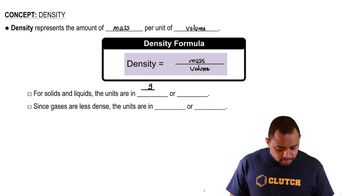
Density is defined as mass per unit volume, typically expressed in grams per milliliter (g/mL) or kilograms per cubic meter (kg/m³). It is a crucial property in determining how much mass is contained in a given volume of a substance. In this problem, knowing the specific gravity allows us to calculate the density of the vegetable oil, which is essential for finding its mass.
Recommended video:

Mass Calculation

Mass can be calculated using the formula: mass = density × volume. In this context, once the density of the vegetable oil is determined from its specific gravity, we can multiply it by the volume (750 mL) to find the mass in grams. This relationship is fundamental in solving problems related to the properties of materials.
Recommended video:
Guided course
01:10
Calculating Molar Mass