
Pearson+ LogoPearson+ Logo
Ch.2 Chemistry and Measurements
Timberlake - Chemistry: An Introduction to General, Organic, and Biological Chemistry 13th Edition
Timberlake13th EditionChemistry: An Introduction to General, Organic, and Biological ChemistryISBN: 9780134421353Not the one you use?Change textbook
Chapter 2, Problem 72a

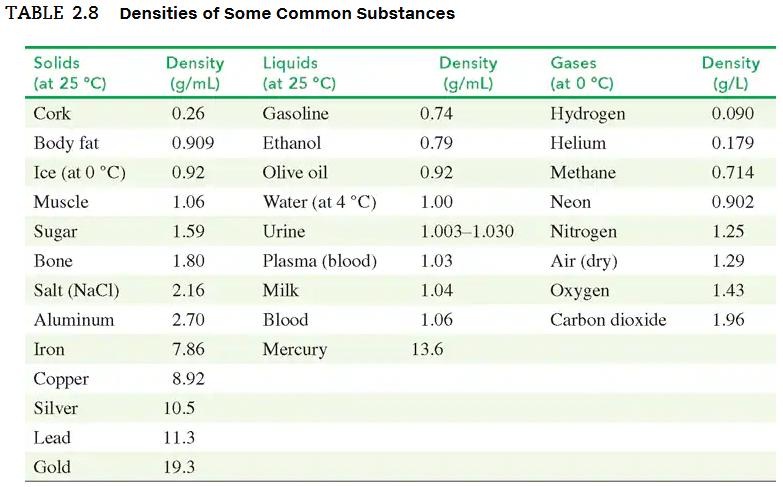
Use the density values in TABLE 2.8 to solve each of the following problems:
Table displaying the densities of various substances, including solids, liquids, and gases at specified temperatures.
a. A graduated cylinder contains 18.0 mL of water. What is the new water level, in milliliters, after 35.6 g of silver metal is submerged in the water?

Verified step by step guidance
1
Identify the relationship between mass, volume, and density using the formula: d=mV, where d is density, m is mass, and V is volume.
Rearrange the formula to solve for volume: V=md.
Look up the density of silver in TABLE 2.8. For example, if the density of silver is given as 10.5 g/mL, substitute m=35.6 g and d=10.5 g/mL into the formula to calculate the volume of silver displaced.
Add the calculated volume of silver to the initial water volume in the graduated cylinder (18.0 mL) to determine the new water level.
Express the final water level in milliliters, ensuring the correct number of significant figures based on the given data.

Verified video answer for a similar problem:

This video solution was recommended by our tutors as helpful for the problem above.
Video duration:
3m
Was this helpful?

Key Concepts

Here are the essential concepts you must grasp in order to answer the question correctly.

Density

Density is defined as mass per unit volume, typically expressed in grams per milliliter (g/mL) for liquids and solids. It is a crucial property that helps determine how much mass of a substance will occupy a certain volume. In this problem, the density of silver will be used to calculate the volume it occupies when submerged in water.
Recommended video:

Volume Displacement

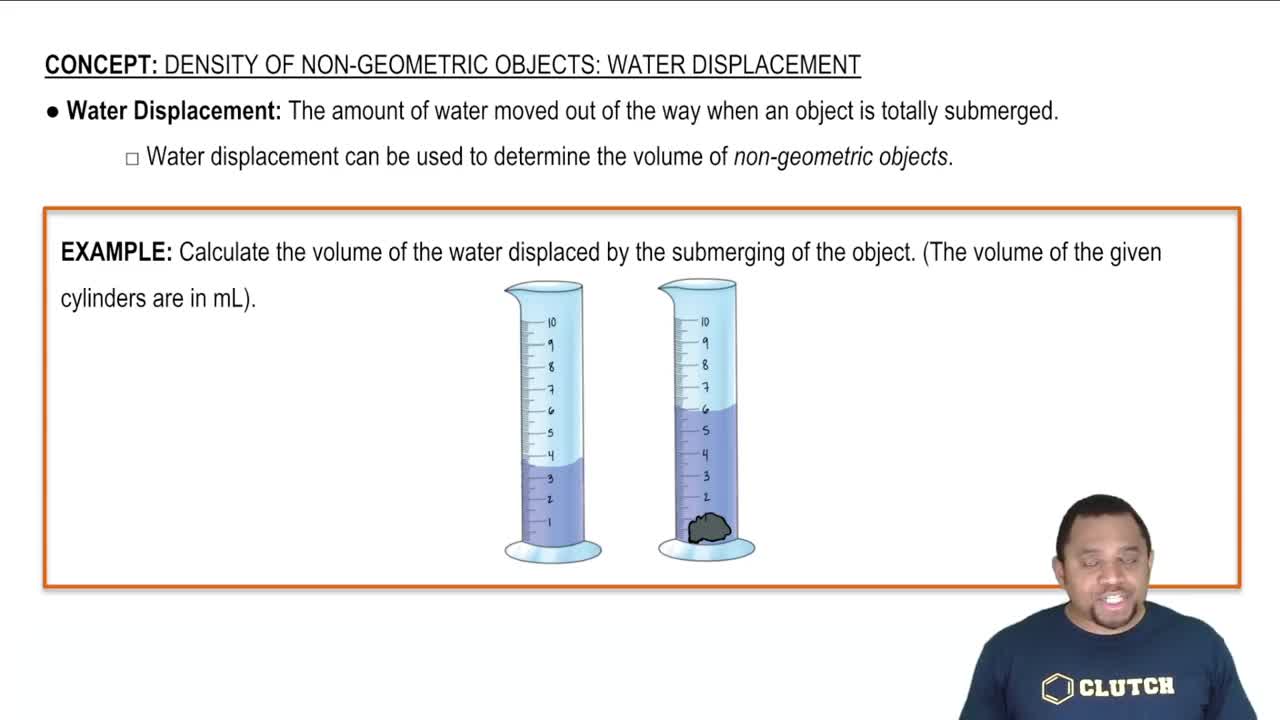
Volume displacement refers to the principle that when an object is submerged in a fluid, it displaces an amount of fluid equal to the volume of the object. This concept is essential for understanding how the addition of silver to the graduated cylinder will affect the water level, as the volume of silver will increase the water level by the volume it displaces.
Recommended video:
Guided course
01:36
Density of Non-Geometric Objects Concept and Example

Graduated Cylinder

A graduated cylinder is a common laboratory instrument used to measure the volume of liquids accurately. It is marked with measurement lines to indicate volume levels. In this problem, the graduated cylinder's initial water level and the final water level after adding silver will be compared to determine the change in volume due to the submerged metal.
Recommended video:
Guided course
01:49
Laboratory Materials